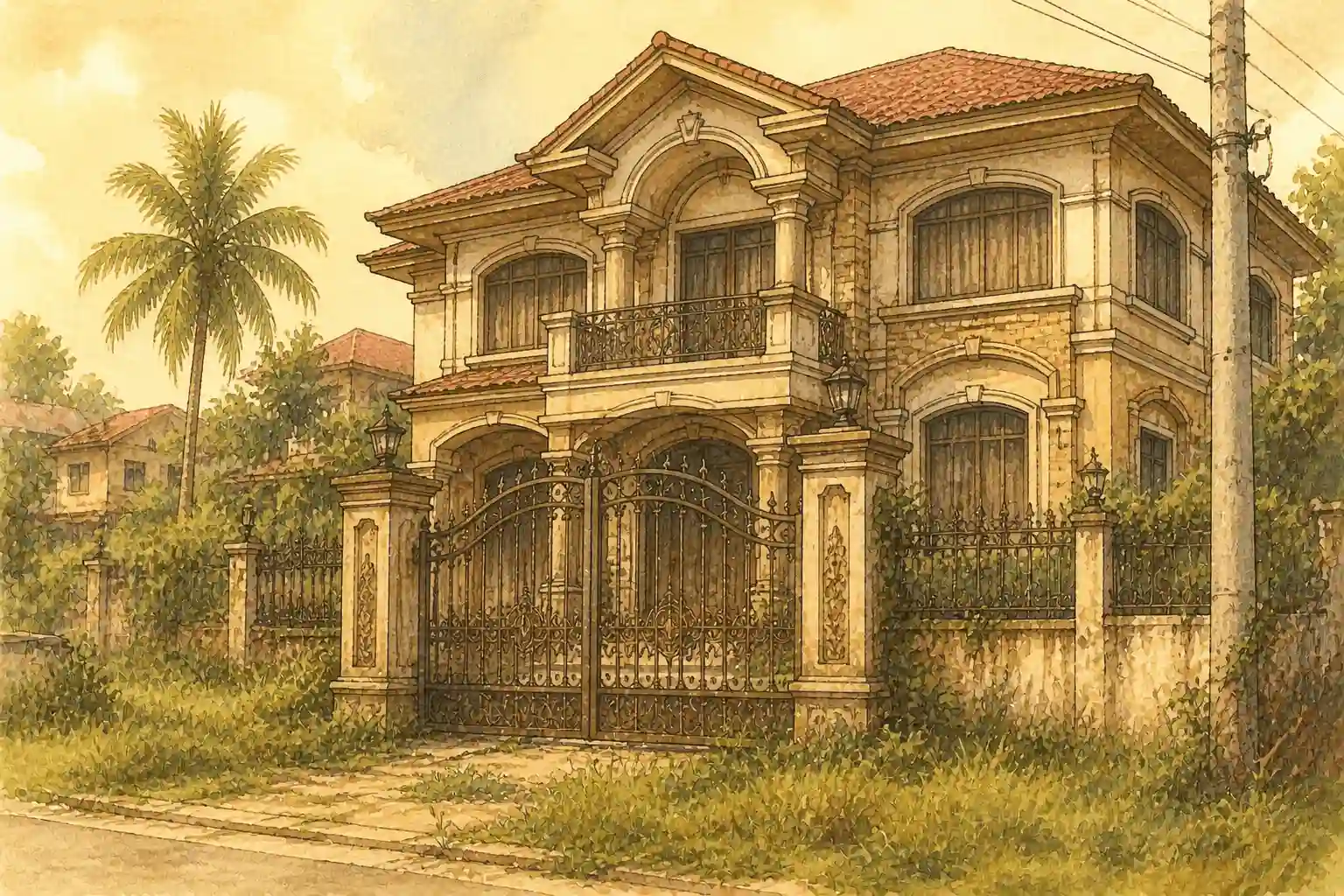
Drive through any province in the Philippines — Batangas, Cavite, Ilocos — and you will notice something strange.
Grand two-story houses with ornate gates and freshly painted walls. The kind of house that would not look out of place in a wealthy suburb. But the curtains are always drawn. The gates are always locked. The grass in the front yard has not been cut in weeks.
Look a little further down the road and you will find another house — just a skeleton of concrete columns and hollow blocks, construction frozen mid-way, weeds growing through the gaps.
I have lived in Amadeo, Cavite for over 13 years. This is not an occasional sight. It is everywhere.
Empty mansions. Stalled construction. Houses that are slowly crumbling with nobody inside to notice.
This is the story of what happens when a dream becomes a liability — and why billions of pesos in OFW remittances are quietly turning into dead capital across the Philippine provinces.
What a House Means to an OFW
For many Filipinos, building a house is not simply about having a place to live.
For an OFW — an Overseas Filipino Worker — who has spent years away from their family, working in conditions that are often difficult and lonely, a mansion back home is proof. Proof that the sacrifice was worth it. Proof to their family, their neighbors, and their hometown community that they made it.
The bigger the house, the louder the message.
My husband Ryan often points out what he calls the “maximize” mentality — the tendency to push everything to its limits right now, without necessarily thinking about what comes next. Build as close to the property line as legally allowed. Skip the parking space. Worry about penalties later. The goal is to build the biggest house possible, as fast as possible, and the details can be sorted out by someone else.
In many cases, that “someone else” is the OFW themselves — still overseas, still working, dealing with violations and penalties remotely while their family back home shrugs.
Condominiums follow the same logic. Developers squeeze as many units as possible into a building, cutting rooms down to under 20 square meters. Not because anyone wants to live in 20 square meters, but because more units means more sales.
The priority is always the number, the size, the appearance. Never the livability.
Construction Stops. Nobody Notices.
One of the most common sights in provincial Philippines is a house frozen in mid-construction.
An OFW takes out a Pag-IBIG housing loan, breaks ground, and starts building. Then the money runs out. Construction stops. The concrete columns stand in the rain for months — sometimes years — until enough money has been saved to start again. Then it stops again. Then it starts again.
The result is a landscape dotted with half-built skeletons that nobody seems particularly concerned about. Grass grows through the hollow blocks. Rebar rusts in the open air.
And when a house is finally finished? Maintenance is rarely part of the plan.
I know of a subdivision nearby — built by the same developer as ours — where several houses are already falling apart. No one is living in them. No one is fixing them. They were built, and then forgotten.
A Buyer’s Market Nobody Is Buying
These days, “FOR SALE” signs are everywhere in Amadeo.
Colliers Philippines has been explicit about the current state of the market: this is a buyer’s market. And the provincial housing sector reflects this clearly — real estate companies have openly shifted focus toward house-and-lot developments outside Metro Manila, precisely because supply has been outpacing demand for years.
And yet, things are not selling.
In my village, there is a house so large it looks like a furniture showroom. A family of three lives there, and apparently the plan is to sell it eventually. The neighbors all say the same thing: “Who is going to buy that?”
A large house nearby has been listed at ₱15 million for a long time now. No takers.
The reason is straightforward. Filipinos who are in the market for a home do not generally want someone else’s oversized dream. They want their own. They want to design it, customize it, and make it theirs — even if that means taking out a loan to build from scratch rather than buying something ready-made.
The result is a one-sided market: more and more people trying to sell oversized houses, and almost nobody willing to buy them.
Pag-IBIG Is Making It Easier Than Ever
Fueling all of this is the increasing accessibility of housing finance in the Philippines.
In recent years, the government has steadily lowered barriers to borrowing — reducing interest rates, relaxing eligibility requirements, and expanding access for OFWs and first-time buyers. The result is visible in the numbers: in 2025, Pag-IBIG released a record ₱140.54 billion in housing loans — an 8% increase from the previous year — benefiting over 90,000 Filipino workers.
Easier access to loans is not inherently a bad thing. But when the culture around homeownership does not include thinking about maintenance, livability, or long-term value, cheaper borrowing simply means more houses get built that probably should not have been built yet.
COVID Sent Everyone to the Provinces
The rush to build in places like Amadeo accelerated sharply during the pandemic.
Locked down in cramped Metro Manila apartments, people started dreaming about space. Land in Cavite and Laguna suddenly looked very attractive. Subdivisions sprouted across the provinces. Real estate companies began openly shifting their focus toward horizontal developments — house and lot projects — outside Metro Manila.
But when the lockdowns ended and remote work arrangements were scaled back, a difficult reality set in: the jobs are still in Manila.
Many of the houses built during this period became weekend houses at best. For OFWs, the situation is even more extreme — the house sits empty for eleven months of the year, waiting for Christmas.
One such house is right in my neighborhood. And I was invited inside once.
Dead Capital: A Chandelier Nobody Sits Under
“Dead capital” is a term used in economics to describe assets that exist but generate no economic activity. They are locked up, frozen, unable to create jobs, income, or growth.
A neighbor’s house near mine is a near-perfect illustration of this concept.
White grand piano. An enormous sparkling chandelier above it. Every piece of furniture in gold and white. The kind of interior you might see in a magazine.
On weekends, a couple in their forties drives up from Manila to check on the place. They bring a maid to clean. Then they leave.
I was invited to dinner there once. The meal that came out was leftover cold pizza. The contrast with the surroundings was difficult to process.
Midway through dinner, they asked if I would speak with the owner over video call. The screen showed a woman in her seventies — the husband’s mother, and the true owner of the house. She was in the middle of her workday in the United States, cradling a white baby on her lap. She worked as a babysitter.
Ryan tried speaking to her in Tagalog. She responded exclusively in American English.
“So — what do you think of my house? How does it look?”
I told her it was beautiful, which it was. She seemed pleased. She asked how big our house was, in the way that people do when they are looking for a favorable comparison.
Then I asked her: “Have you been able to visit?”
“Not yet,” she said. “I haven’t been there yet.”
She had never seen her house in person.
The money earned cradling someone else’s baby in America had become a chandelier in Cavite. A grand piano. Sofas that nobody sits on. This is what dead capital looks like in practice.
OFW remittances are one of the pillars of the Philippine economy — totaling around $40 billion in 2024, roughly 8–9% of GDP. A significant portion of that money flows into concrete that generates no jobs, produces nothing, and slowly deteriorates.
In a healthier business environment, that money might flow into local enterprises — small manufacturers, logistics companies, service businesses that employ people and circulate wealth. But starting a business in the Philippines means navigating complex LGU requirements, high electricity costs, and significant regulatory risk. Pouring money into a house feels safer. In many ways, it is.
The dead capital problem is not just a cultural failure. It is also a structural one.
Notably, the term “dead capital” does not appear in any Philippine government policy document. The government’s attention is focused on the opposite problem — a housing backlog of 6.5 million units, informal settlers living in flood-prone areas, and the difficulty of providing affordable homes for low-income families. The problem of oversized, underused mansions built by OFWs has not yet made it onto the policy agenda at all. When a problem is not visible to those in power, it does not get solved.
The contrast with the Chinese-Filipino community — known locally as Chinoy — is striking. I wrote more about how Chinoy families think about money in Why Filipinos Can’t Get Rich. Wealthy Chinoy families do not typically build oversized provincial mansions. Capital flows into businesses instead. The financial logic is fundamentally different, and so are the outcomes.
For most non-Chinoy Filipinos, the business option is rarely on the table — not because they have considered it and rejected it, but because it was never really part of the mental framework to begin with. The plan was always the house. And the reasoning is not entirely irrational: buy land, use it for weekends and family gatherings, benefit from rising land values, sell if things get difficult. In theory, property is not a bad investment. In practice, the house does not sell, sits empty, and deteriorates.
Starting a business in the Philippines is genuinely hard — not just because of LGU red tape and high electricity costs, but at the most basic level of employment. Ryan’s mother ran a small sewing business as a family enterprise for years. She dealt with workers who constantly asked for salary advances, theft, employees who disappeared without notice, and people who left as soon as they had developed any real skill. Building and keeping a reliable workforce is extraordinarily difficult. When the alternative is pouring money into concrete, which requires no staff and generates no interpersonal conflict, the choice starts to make a certain kind of sense.
The most precarious situation, though, is not the individual OFW building their dream house. It is the family structure that depends entirely on one or two overseas workers to sustain everything. We bought our home within our means — that was a conscious decision. But in many families, an entire extended clan is leveraging the income of a single OFW, taking out loans that only work if that person keeps earning, overseas, indefinitely. If that OFW gets sick, loses their job, or simply wants to come home — the mansion stops being a dream and becomes a burden overnight.
Built and Forgotten
The “maximize now, think later” pattern shows up in the physical details of these houses too.
Property boundary rules are pushed to their legal limits — or beyond. Parking is an afterthought. Glass facades that look impressive in photos turn provincial homes into ovens during summer. Most houses here are built from hollow concrete blocks. Amadeo is not as hot as Metro Manila, but it is not cool either. Our home is built with SRC panel construction, which makes a real difference in comfort. Most houses here are not.
The uncomfortable truth, I think, is that many of these houses are not really being purchased as assets. They are being purchased as dreams. The goal is the house itself — the moment of completion, the photos, the reactions from family and neighbors. What happens after that is a problem for later.
Similar patterns have appeared in other countries. In Japan, the bubble-era resort condominiums of the 1980s and 1990s are now largely abandoned — unable to cover maintenance fees, deteriorating quietly in mountain and coastal towns across the country. The desire to buy a dream, when it collides with borrowed money and social pressure, produces similar results regardless of culture.
In the Philippines, however, the OFW structure gives this pattern a particular scale and intensity. The person funding the dream is often thousands of kilometers away, unable to see the cracks forming — literally and figuratively.
Living Small, Living Carefully
Writing this piece made me realize something uncomfortable. I own two condominium units in Manila. One is rented out. The other has been sitting empty. Which means that, by my own definition, I have been sitting on dead capital too. It is easy to observe a pattern from the outside. It is another thing to notice it in your own balance sheet. I plan to fix that soon.
Driving through the province, I feel a quiet sadness watching the unfinished houses and the ones already starting to fall apart.
Land gets cleared. Houses go up. Then they sit, unused, until the concrete starts to crumble and the weeds take over. We built our home too, which makes us part of this story. But it also makes me grateful — genuinely grateful — that we chose to build small, and that we take the time to look after it ourselves.
Not all Filipinos approach housing this way, of course. There are voices that advocate for exactly the kind of financial diversification that would break this cycle: one part assets, one part business, one part investments. But the pull of the dream is strong.
And when the dream is a grand house back home — something visible, something that says “I made it” to everyone who drives past — it is hard to compete with a mutual fund or a small business investment that nobody can see.
The capacity to pursue a dream against all odds is something I genuinely admire about Filipino culture. That resilience is something I wrote about in Why Filipinos Smile Through Everything.But every time I pass one of those empty mansions, I find myself hoping that one day, someone will actually come home to it.
This article is also available in Japanese: Built and Forgotten? The Reality of Mansion Ghost Towns Spreading Across the Philippine Provinces