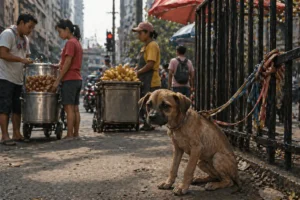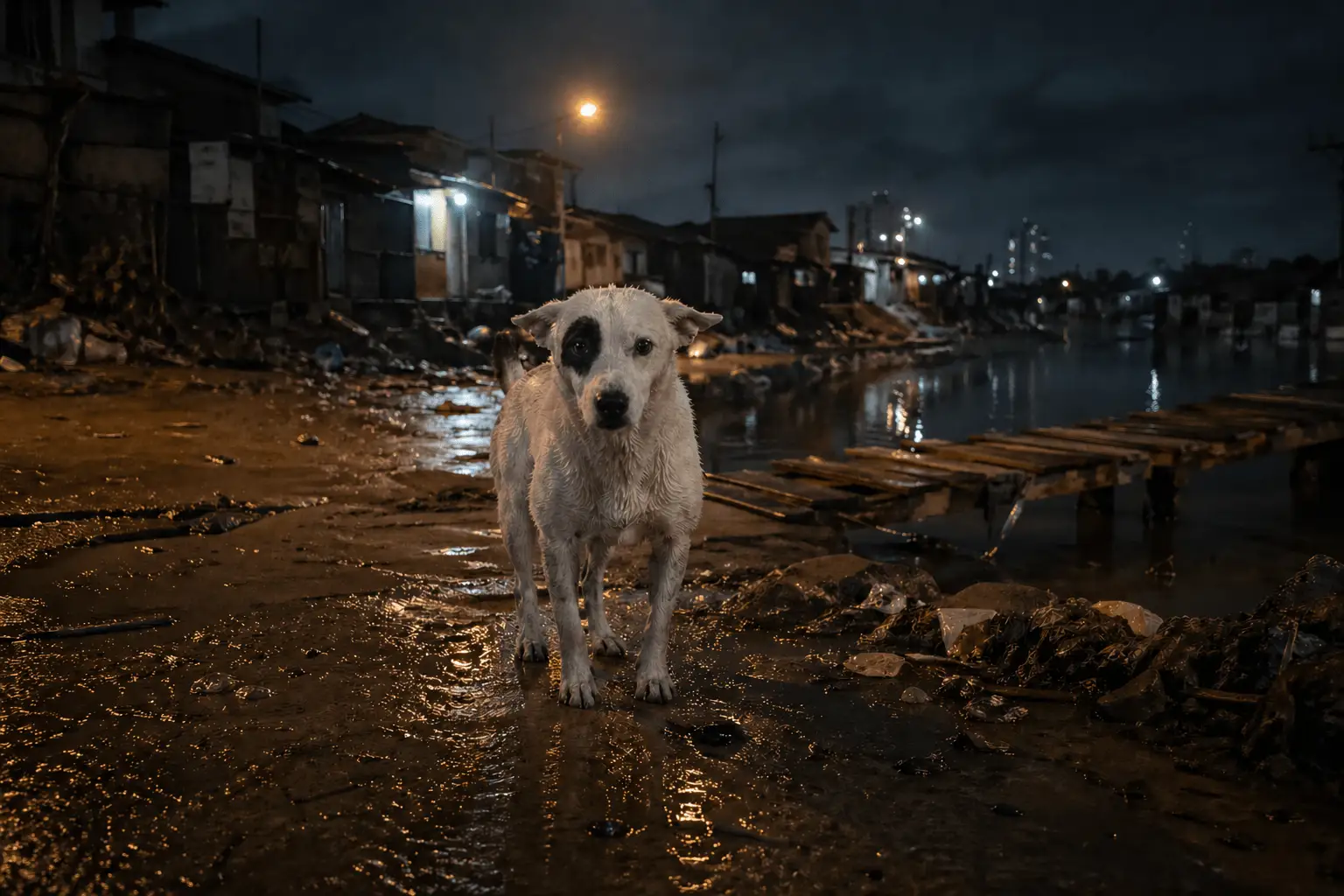
A week after we brought Amber home, we ended up with another dog. This is the story of Isla — an Aspin, a Filipino mixed-breed — and it’s a different kind of story altogether.
One Week After Taking in Amber
I’d known Isla long before she came to live with us.
On both sides of a road we passed regularly, families had set up their lives on the pavement. People cooking, sleeping, living — right there on the sidewalk. Not an unusual sight in the Philippines. Isla belonged to one of those families.
From the time she was a puppy, she knew our faces. Every time we walked past, she’d bark at us. Once, I found her crammed inside the small wire cage that covers a street-side water meter — maybe 30cm x 20cm x 20cm — completely unable to move, just sitting there frozen. I couldn’t look directly at her.
If a dog belongs to someone, it’s not really my place to say “the way you’re keeping this dog is wrong.”
But why would anyone do that?
The Night of the Typhoon
A few months after Isla had grown into a large dog, a typhoon passed through.
Ryan and I were walking outside that night when we heard it — frantic barking, somewhere nearby. There was no one else around, and every time we tried to move away, the barking grew more desperate. It was clearly directed at us.
We looked around. Nothing. We followed the sound toward a dirty canal nearby and stopped at a makeshift bridge crossing it.
Wedged sideways between a wire fence and a tangle of branches spreading out like vines was a large white dog.
It was Isla.
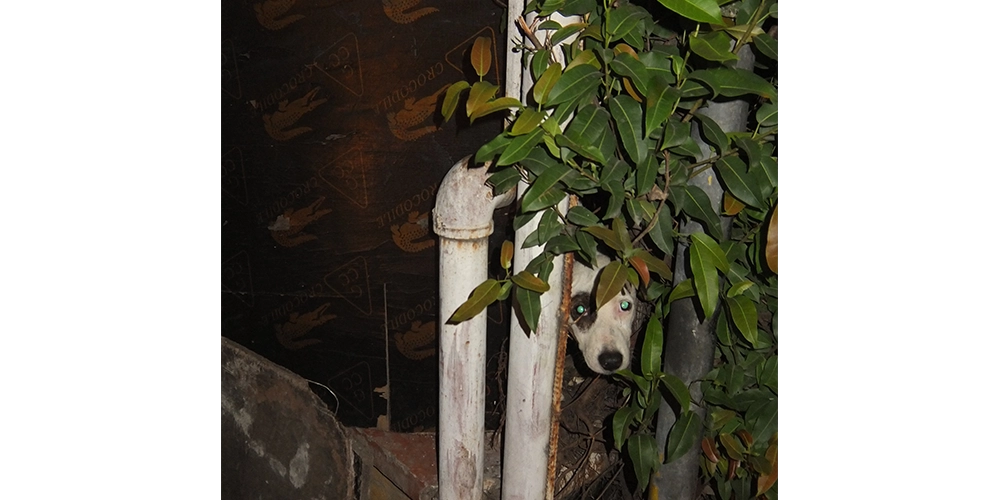
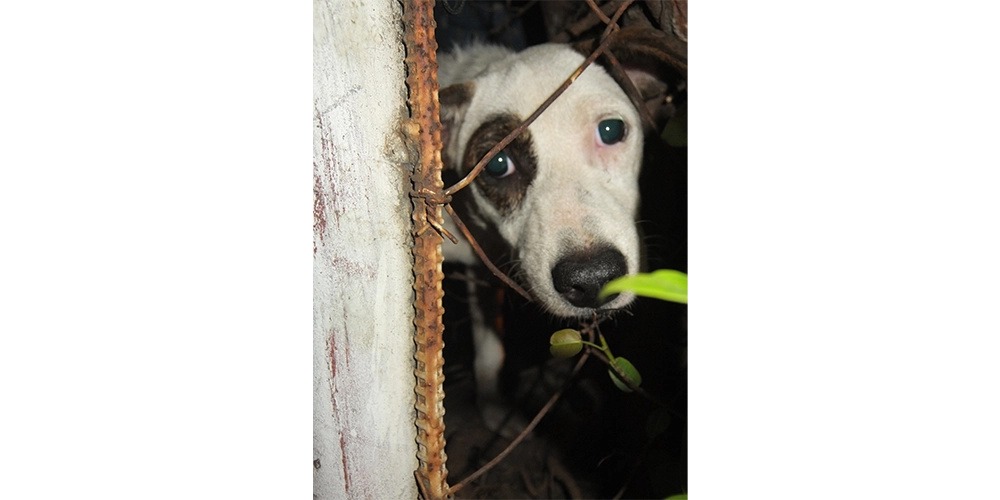
The area around the canal — called an Estero in Filipino, essentially an open drainage channel — was overgrown with vegetation. Isla was stuck right in the middle of it. Less than 10% of the Philippines has proper sewage connections, and even in Manila it’s only around 30%. Infrastructure here is a different world.
She was jammed in tight — sandwiched — face completely immobilized, still crying.
We had to get her out. Which was easier said than done. Even though she knew us, grabbing a panicking dog in that state is genuinely dangerous. But Isla went still. Like she understood we were trying to help.
The Next Day, at the Fire Site
The next day, we passed the same spot. Isla was tied up again.
A few days earlier, there had been a large fire on that corner where the group had been living. The buildings were demolished. Rubble everywhere. And in the middle of it, Isla was tied up.
The rope was too short for her to lie down or move into the shade. Around her neck, where a chain had been wrapped, there was a wide, raw wound.
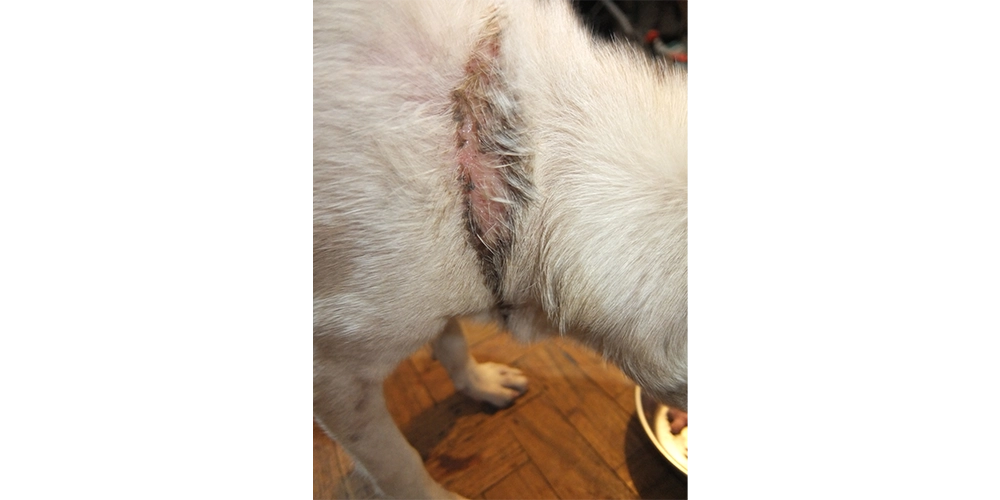
I couldn’t not say something.
Her owner handed her over without a word. No negotiation. He just gave her to us.
A few days later, the family showed up at our house. They had another dog with them, grinning, hand outstretched.
“Want another one? Pay us this time. We’ll give you a good price.”
I wonder — what’s your reaction to that? “Unbelievable. What kind of people are these?” Maybe.
For me, it wasn’t anger exactly. It was more like a massive, blinking realization. The gap in values here — it’s not just different, it’s like a different planet entirely. And there was zero malice in it. None. Why?
Their Measuring Stick and Ours
Until we moved to another part of the city, we ran into that family often.
They called Isla “Black Eye.” When they did, she’d respond — she’d walk over and greet them. But after a moment, she’d turn back toward us, as if to say, I have a new family now. See you.
Watching that, something settled into me.
When we see people living on the street with a dog, our instinct is to feel sorry for the dog. But that’s our lens. For people living that life, what they gave that dog may have been everything they had.
Stuffing Isla between the fence and the branches on a typhoon night — that was their way of keeping her safe from the storm. Cramming her into the water meter cage — that was to keep her from being taken away by the pound. They didn’t have money to reclaim her. They didn’t have another option.
All of it was their version of keeping her safe.
I asked Ryan why they’d do things that way.
“If you look closely at how those people are living, I think you’d understand. Their measuring stick is just too different from ours.”
Then, after a pause:
“But the dog was probably suffering. That part’s still true.”
There was another dog I couldn’t stop thinking about. A thin dog tied up beside a small canteen near where we lived. The canteen owner told me the dog belonged to a pedicab driver. When he went out to work, he’d leave the dog there so it could get scraps.
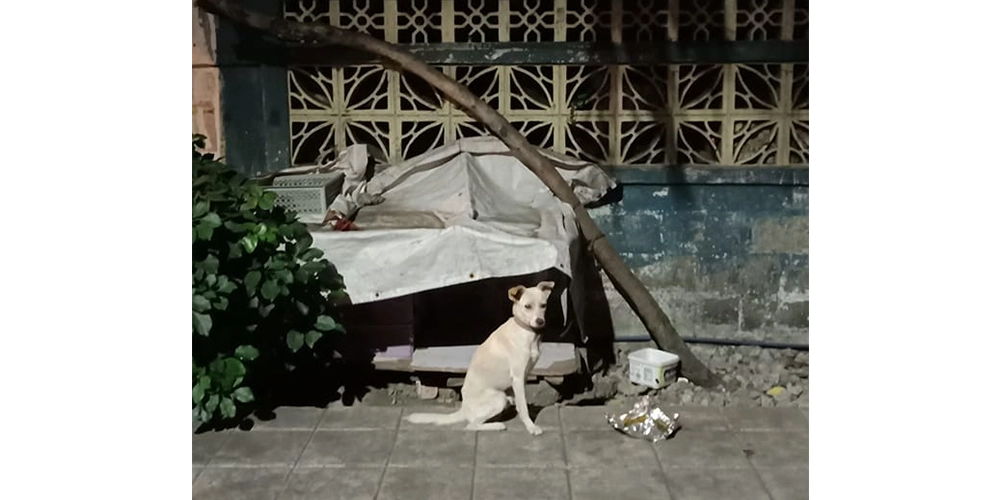
The dog would sit facing the direction the owner had gone, and just wait.
The driver didn’t have a proper home. He slept in his parked pedicab. The dog was tied up outside it. But when the owner came back, that dog’s tail wouldn’t stop wagging.
Was the dog happy? Or did it simply not know any other kind of life?
That’s their world — dog and owner, together. Who am I to judge?
Our measuring stick isn’t the only one.
I’ve thought about that, over and over, since the day we brought Isla home.
The Problem We Couldn’t Fix: Isla’s Aggression
Isla is, at her core, a gentle dog.
She follows commands well. She gets along with other dogs at the pet hotel. She’s social, friendly, warm with people.
But there’s a serious problem. Toward dogs she perceives as lower-ranking within her pack, she becomes a completely different animal. Not toward strange dogs. Toward Mochi and Amber.
Eyes red, going for the throat, going for the eyes, trying to bite through tongues. Every time I found the other dogs covered in blood, I didn’t know what to do.
We tried training. We consulted specialists. We tried keeping her outside full-time. Nothing worked.
We genuinely tried to find her a new home. We contacted shelters. But no one is going to take a dog with a history of attacking other animals. We knew that going in, and we tried anyway.
I thought about euthanasia. Seriously.
But after each attack, Isla would tremble. Like she herself didn’t know what had come over her.
After we moved to Amadeo, something shifted. Isla started going upstairs on her own — creating distance from the other dogs, by herself. Now, when we go out, she’s fully separated. She doesn’t share a space with Amber and Mochi. She comes downstairs to eat and to walk, then heads straight back up.
Isla spends most of her time on the second floor. That’s the best answer we’ve been able to find.
Living with Dogs in the Philippines: On Euthanasia
Since Isla came into our lives, I’ve thought a lot about the idea of zero euthanasia for animals.
Things happened that made it impossible not to.
Putin the Puggle was surrounded by a pack of five street dogs on a walk. He was bitten on the hindquarters — significant bleeding. Our French Bulldog Jinping was attacked by two dogs. Ryan landed a flying kick that actually worked and drove them off, but it wasn’t funny. A pack charged our gate once — we have the video. A neighbor’s dog was killed by the same pack. We found a stray cat dead on the road, attacked, and buried it ourselves.
This is the reality of where we live.
In the Philippines, stray dogs sometimes kill people. People die from rabies. In that environment, “zero euthanasia” is a principle that the actual animal management infrastructure here cannot support — because that infrastructure barely exists. Most strays haven’t been vaccinated against rabies or distemper. And here’s the part that surprises people: even some pet owners don’t vaccinate their dogs.
What if it had been a family member? What if it had been a child?
Living here has taught me that applying a Japanese standard of “but they’re living creatures, we have to protect them” to every situation isn’t just naive — it can be genuinely dangerous. Whether it’s rescue or population control, decisions have to be grounded in the reality of this place.
Should we help stray dogs? Should we not? I still don’t know. I’ve considered euthanizing a dog I rescued more than once. I still don’t have an answer.
A large dog with black eye patches is sleeping upstairs today.
Isla is my favorite dog.
Her name is Isla. In Tagalog, it means island.
🐕🐾 The story of Amber, who arrived one week before Isla, is here 🐾🐕
🇯🇵Japanese article : アスピンのイスラと、路上で生きた人たちのこと