“Just replacing a door” — you wouldn’t expect that to involve demolishing your wall, right?
Apparently in the Philippines, this is completely normal. Nobody told us.
Our house was brand new — completed in June 2025. The front door was equally new: solid mahogany, sturdy and beautiful.
Or so we thought.
We completely underestimated the Philippine climate.
During dry season, the wood dried out and cracked. During rainy season, it absorbed moisture and swelled. Repeat. Eventually, opening and closing the door became a serious workout.
Since my husband Ryan and I are about as far from DIY-types as you can get (we don’t even own a saw), Ryan came up with a creative solution: he started shaving the door with an old kitchen knife.
A grown man. Scraping a door. With a cleaver. It was oddly cinematic.
We kept managing like this until one morning — the day we had to leave for a friend’s wedding where we were invited as godparents. Two nights away. We were all packed and ready to go when:
The door itself shut fine. But it had swollen so much that the latch and strike plate no longer aligned. No matter how many times we tried, it just wouldn’t catch. The clock was ticking.
We left the house unlocked.
Nothing valuable was inside, but that did absolutely nothing to calm my nerves. Sitting in the car to Manila, Ryan and I made a solemn pact:
Custom-made doors sound expensive, but it turns out installation included can come in well under ₱50,000 (around USD $850–900) depending on the specs. Ours ended up in that range.
We live in the highlands of Cavite Province — a region rich in timber, where roadside shops selling handmade doors and furniture stretch for kilometers. Premium hardwoods like narra and kamagong are available for prices that would make any Westerner’s jaw drop. (Some species are technically protected, but that’s a different conversation.)
Address: Purok Tres, Brgy. Lumil, Silang, Cavite
Walking up to the shop, I immediately noticed something: instead of a wall, the storefront was lined entirely with sample doors. Very on-brand. Very Filipino.
The owner, Rochel , is a warm and sharp businesswoman who loves Japan — her sister is married to a Japanese man living in Gifu. We hit it off immediately.
After explaining our situation, we decided to replace both the front door and the back door. The wood we chose this time: Tanguile — a more dimensionally stable species widely used in Philippine construction, less prone to swelling than mahogany. We also confirmed that the lumber would be properly kiln-dried. Lesson learned.
Then, as Ryan and Rochel were going over the details, the conversation shifted:
“…so, should we also replace the hamba (door frame)?”
“Wait — can’t we reuse the existing frame?” I asked.
“It’s better to replace it properly. Let’s do it right,” Ryan said.
I pictured a wooden frame set into concrete. A bit of chiseling, maybe. No big deal.
I was so wrong.
Pricing breakdown:
Item Size Price Front door 90 × 210 cm ₱13,500 Front door frame (hamba) 2×4 inch ₱5,500 Back door 70 or 80 × 210 cm ₱11,000 Back door frame (hamba) 2×4 inch ₱5,500 Total ₱35,500 50% deposit ₱17,750
Wood: Tanguile, kiln-dried and finished. Door thickness: ¾ inch (finished size approx. 89.5 × 210 cm).
We paid the 50% deposit (₱17,750), and Rochel said someone would come by around 4pm to take measurements. Rochel was more professional than most contractors I’d encountered anywhere. I felt good about this.
“Done in 3 Weeks” — Plus the Hidden Costs
New doors are made from scratch. We have been given an update on the process. Work on the doors began immediately. “It’ll be ready in about three weeks,” Rochel said.
Here’s something important to know if you’re doing this yourself:
The ₱17,750 we paid covered only the manufacturing of the two doors and two frames.
Not included:
Doorknob installation
Drilling for doorknob holes
Delivery
Labor / installation
If you’re thinking “wait, ALL of that is separate?” — yes. And apparently this is standard in the Philippines. When a house is built, the contractor handles door installation as part of construction. The concept of replacing just a door afterward isn’t something the industry has really structured around. We hired Rochel’s team for the installation separately.
Installation Day: “We’ll Be Tearing Down the Wall”
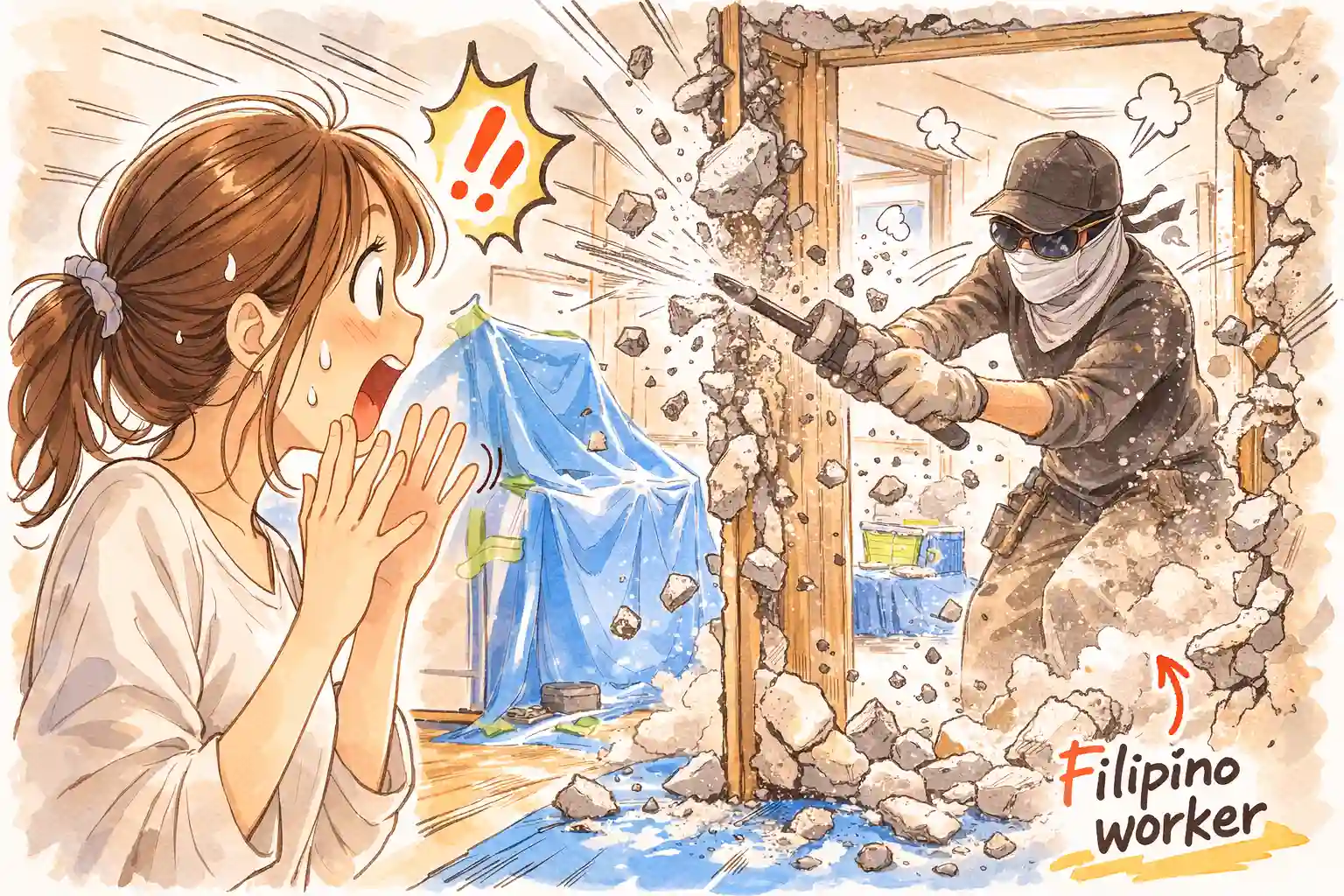
Make no mistake! He’s not a burglar. He’s Mr. Nelson, the guy who installed the door. Three weeks later. An extra ₱1,500 for the doorknob drilling, and installation day had arrived.
Rochel and her carpenter, Nelson , showed up on a single motorbike. Two people, one bike. Peak Philippines.
I had one private concern going into that day: the concept of “protective sheeting” essentially doesn’t exist here.
When wood gets cut and concrete gets broken, the dust and debris fly freely into every corner of your home. So I had gone ahead and purchased two blue tarps in preparation.
“We should cover everything!” said Rochel.
“Yes! Let’s seal off the work area with the tarps!” I replied enthusiastically.
Rochel, Ryan, and Nelson exchanged a look.
“No no, it’s too early for that.” “The tarps go on the FURNITURE.” “If you seal off the work area, Nelson can’t move.”
The look on their faces said: what is this woman on about.
The tarps ended up draped over our furniture. Our little loft became a full construction site. The dogs ran in and out in a panic. Dust settled over everything.
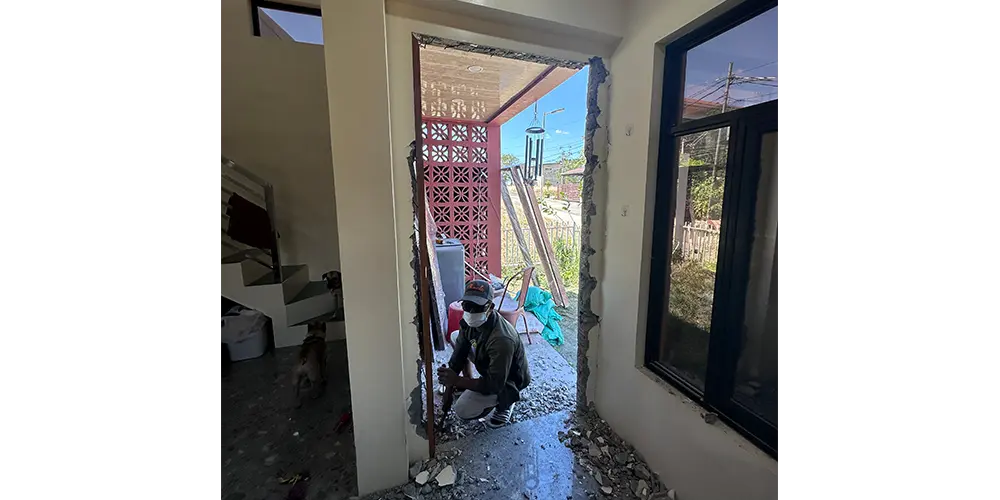
Then Nelson picked up an angle grinder and cut a line into the wall — not just around the frame, but 5–7 centimeters deep on either side.
Wait… does the frame really need that much clearance?
Then he pulled out a chisel and started hammering it straight into the concrete.
Philippine door frames are embedded directly into the concrete wall with cement. To remove one, you have to break the surrounding wall. There is no gentle option.
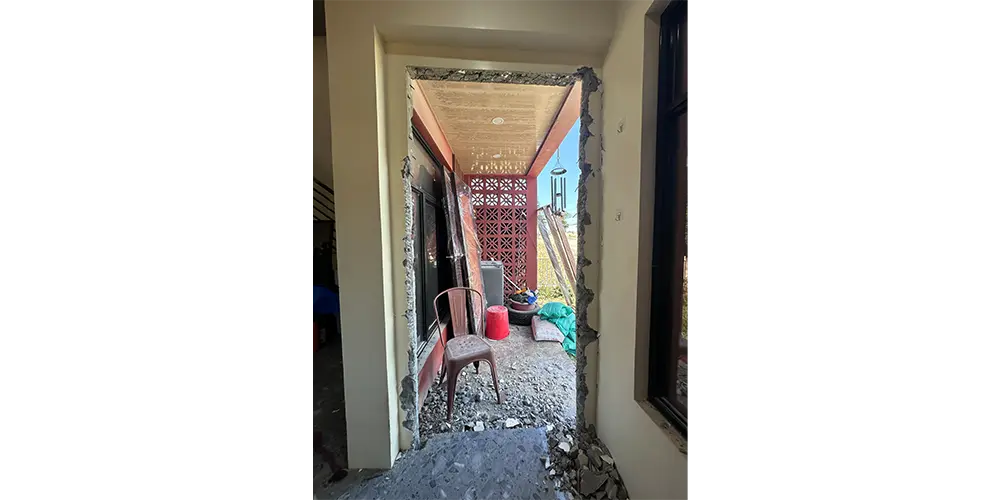
Chunks of concrete hit the floor. Cracks spread across the wall like a spiderweb. Each time Nelson pried at the frame, the damage spread further.
Our brand-new front entrance — completed just last summer — had become a bomb site.
It was quite a shocking sight. Finally, the door frame was removed. I turned to Ryan, pale.
He grinned. “You’re the one who wanted a new door, Kumi-chan. 😂”
I had nothing to say about the aluminum door option.
Demolition was about 80% complete when noon arrived. Nelson announced he was heading out for lunch and walked out the door.
He did not return for three and a half hours.
No message. No phone call. Completely unreachable.
This is not entirely unusual on Philippine job sites:
Some workers don’t carry smartphones
“Lunch break” has no guaranteed end time
Workers sometimes bring their pets — and occasionally leave them behind
I knew this going in. But waiting with your front entrance half-demolished is a special kind of anxiety.
I called Rochel, who reached out through Nelson’s wife. There was nothing to do but wait — sitting on rubble, watching the driveway.
When Nelson finally returned, demolition resumed. By evening, the new door frames (hamba) were installed — but the doors themselves had to wait. The cement needed time to cure, so everything was left rough.
Through the gap between the wall and the new frame, I could see the sun going down.
Romantic, in a way. If you ignore the fact that we had no door.
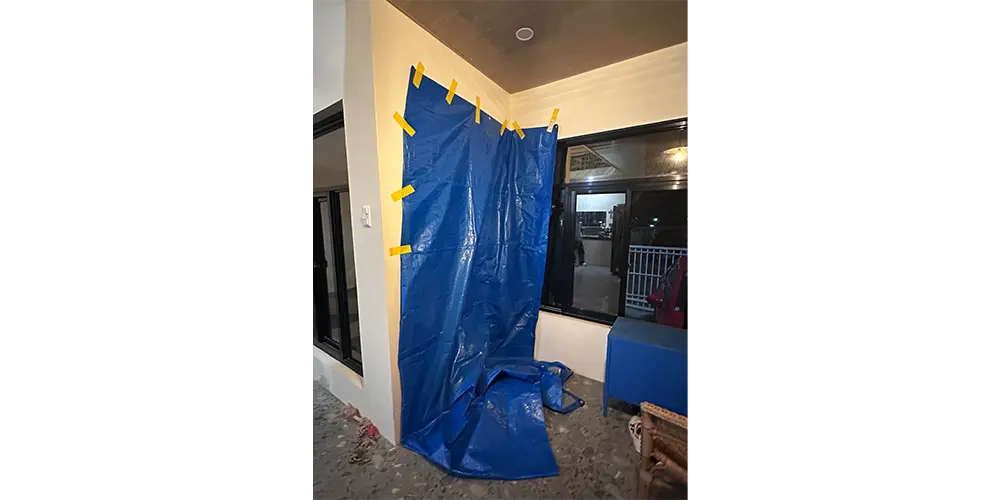
That night, my blue tarps finally found their purpose: taped across the open doorway with yellow duct tape to seal the entrance.
On the first day, we slept with the opening covered with a tarpaulin. Blue tarp. Yellow tape. Oddly, it looked just like an IKEA color scheme.
Day 1 was over.
Day 2: Nelson Doesn’t Show Up
Nelson was supposed to arrive at 9am.
By 11:30am, still no Nelson.
I messaged Rochel:
“Waiting for him feels like waiting for a ghost — no idea when he’ll appear.”
I also made clear: “In this state, I’m not paying the full labor fee.”
Rochel — professional to the core — took my frustration seriously and came back to the house herself to supervise.
Nelson eventually showed up in the early afternoon. His explanation:
“On the way here, I came across a traffic accident. A man delivering water by motorbike had died. I rode with him to the hospital.”
Detailed. Specific. Emotionally compelling.
Ryan was the only one who believed him.
That day, good progress was made: the back door frame and door were installed, and the cement was roughly 80% filled in.
Then we discovered another hidden cost: smoothing and painting the repaired wall sections was not included in the labor quote.
We paid extra to have it finished properly.
Day 3: Philippine Wabi-Sabi
Day 3. Nelson arrived at exactly 9am.
First came the masilla (base coat/filler). The internet says to wait 24–48 hours before painting over it. Nobody mentioned this, and nobody waited — the paint went on immediately.
By 5pm, the job was done.
I looked at the wall finish and said:
“…it looks like a homemade birthday cake. The texture.”
Bumpy. Organic. Decidedly handmade.
Ryan beamed. “That’s Philippine Wabi-Sabi.”
But the door itself? Absolutely beautiful.
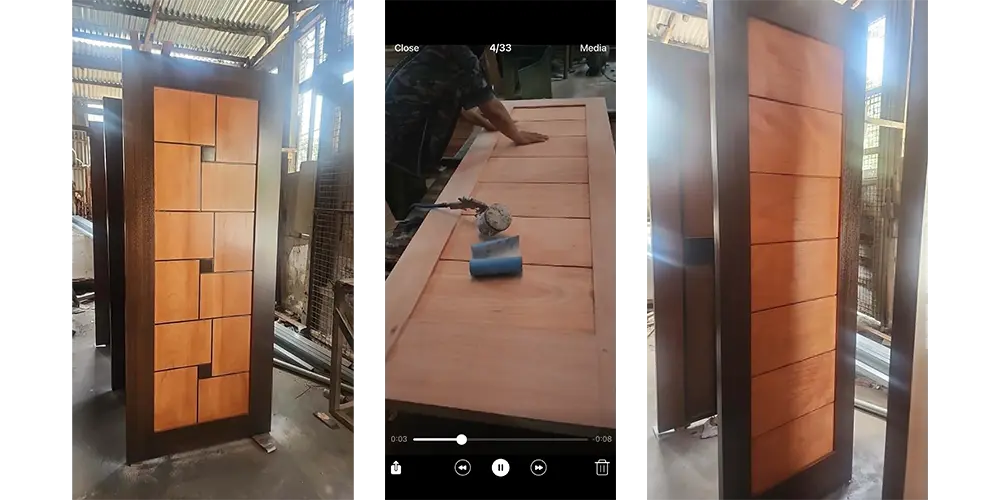
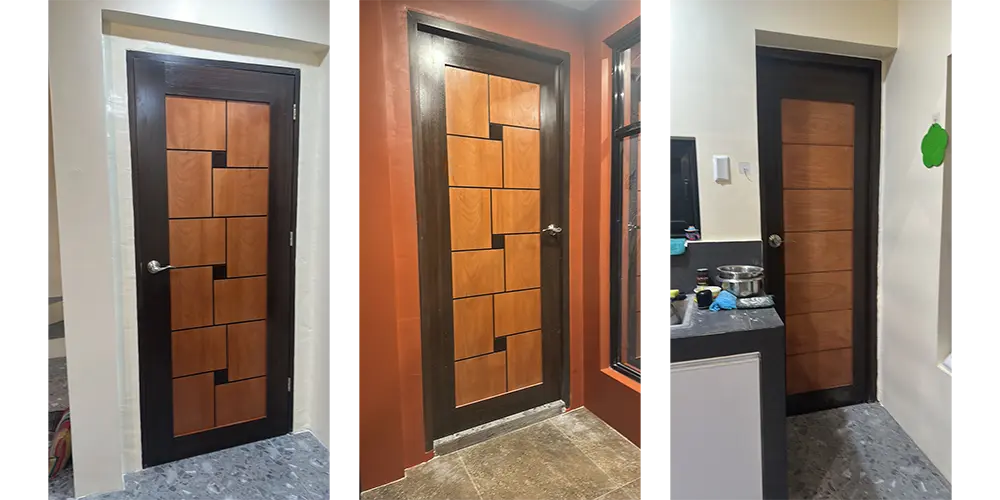
Take a look at these beautiful doors. The cement part looks a little handmade, but the two doors are a work of art. Heavy, solid, dignified. Every time you open or close it, you feel the quality. The thicker frame gave the whole entrance a permanence the original never had.
The wall around it has “character.” But the door? Five stars.
No regrets. Totally worth it.
Although — I am extremely glad we didn’t touch the balcony door.
And if I ever need to replace a door again: the hamba (frame) stays. No matter what.
Full Cost Breakdown
Item Cost 2 doors + 2 frames ₱35,500 Doorknob drilling & fitting ₱1,500 Labor (installation) ₱7,500 Materials (paint, masilla, cement) ₱3,450 Delivery (Lalamove) ₱1,577 Total ₱49,527
At roughly USD $860–880 for two custom hardwood doors fully installed, this is essentially impossible to match in Japan, the US, or most Western countries. Philippine timber culture and local craftsmanship make it genuinely affordable.
(We also ended up with a significant pile of leftover cement. No idea what to do with it. We’re keeping it. Just in case.)
Lessons Learned
1. Replacing the door frame means demolishing your wall
Philippine door frames are cemented directly into concrete walls. Agreeing to replace the hamba is agreeing to significant structural demolition. Unless you have a strong reason, keep the original frame.
2. Get a line-item quote before committing
Door fabrication, drilling, delivery, installation, and wall finishing are all typically quoted separately. Before signing anything, ask: “What is the total cost for everything, start to finish?”
3. Handle your own protective sheeting
Dust protection isn’t part of the standard workflow here. Bring your own tarps and plastic sheeting — and expect to cover your furniture, not the work area.
4. Build buffer time into your schedule
Lunch breaks can run 3+ hours. Workers may not show the next day. Having a reliable point of contact like Rochel — someone who will actually follow up — is invaluable. For short projects (1–2 days), you might also consider asking workers to eat lunch on-site.
5. Let go of “proper procedure”
Base coat should dry 24–48 hours before painting. It won’t. Adjust your expectations and focus on the end result.
Summary
The demolished wall, the vanishing carpenter, the hidden fees, the lumpy finish — this is just what home renovation looks like in the Philippines. Once you know that going in, you can laugh at it instead of panic.
The custom doors themselves were genuinely excellent. That much I will always stand behind.
If you’re renovating a home in the Philippines: come prepared with tarps, a flexible schedule, a good contact like Rochel, and a sense of humor.
And please — leave the hamba alone. 😄
Bonus: Why Do Philippine Homes Use Wood Doors in a Tropical Climate?
It’s a fair question — all that humidity, and yet wooden doors everywhere.
The answer isn’t really about climate suitability. It comes down to tradition, workability, and aesthetics. Wood has been central to Philippine construction for generations, and it’s easy to cut and adjust on-site — which suits a building culture where custom fitting is the norm.
The real issue is curing. Improperly dried lumber absorbs moisture, swells, and cracks — exactly what happened to our original mahogany door. If you choose a wooden door, always confirm that the lumber has been kiln-dried before use.
✍ Author
Kumiko Sato
Japanese writer based in the Philippines. She writes about Filipino culture, food history, and everyday life from the perspective of a Japanese–Filipino household.
→ Read the author profile
👉Japanese article is here : https://pinashaponlife.com/culture/philippines-custom-door/