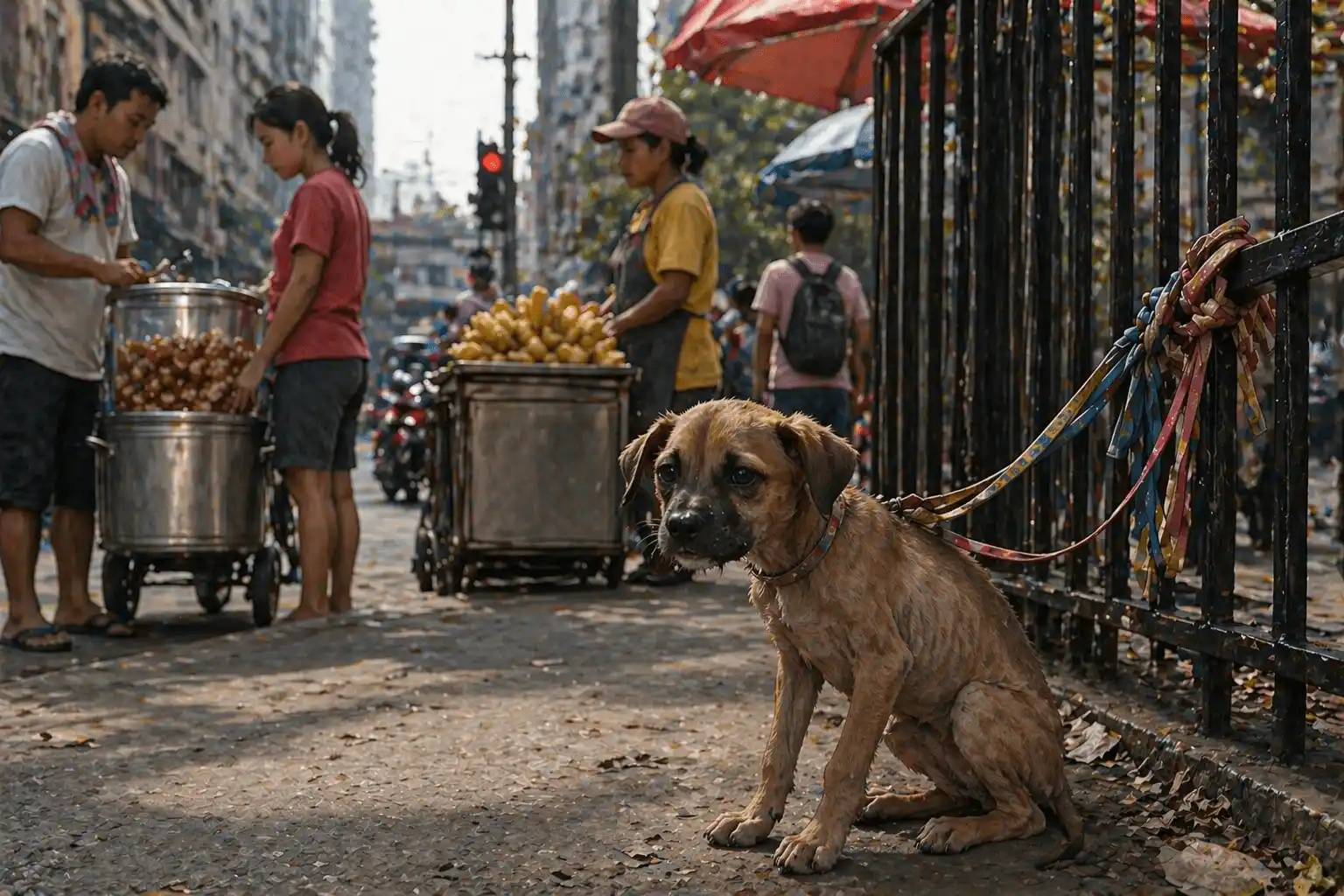
We were supposed to go out for 31 Ice Cream on Ryan’s 31st birthday. Instead, we came home with a dog.
This is the story of Amber, our Aspin.
Waiting for the Bus
It was eight years ago.
Ryan and I had a plan: celebrate his 31st birthday with 31 Ice Cream — that’s Baskin-Robbins, as it’s known here in the Philippines. Simple enough. We headed to a nearby mall, waiting for a bus at Buendia in Makati. Buendia isn’t an official bus stop, but it’s one of those spots where buses have always pulled over, and locals have always gathered.
The corner was its usual chaotic self — taho vendors, boiled corn, dust, noise, people everywhere.
That’s when we heard it.
A puppy, tied to a fence, crying non-stop.
In the Philippines, mixed-breed street dogs are called Aspin — short for Asong Pinoy, meaning “Filipino dog.” They’re sharp, adaptable, and completely woven into daily life here. This puppy was one of them.
She was tied up with whatever had been available — ribbons from gift wrapping, an ID lanyard, several cords knotted together into one long leash. Painfully thin. Ragged. Crying her lungs out.
I assumed she belonged to one of the vendors. Then two security guards appeared from inside the building.
“…We’ll have to take her to the pound.”
That’s when I understood. She’d been abandoned. Left tied to that fence since before six in the morning, crying for hours, belonging to no one.
One of the guards scooped her up — she fought the whole time — and looked straight at me.
“Make Her Yours”
“Ma’am, just take this dog. She goes to the pound, she’s done.”
(“Ma’am, sa inyo na po ’to. Pag napunta pa ’to sa pound, wala na ’to.”)
Wow. Okay. Very casual way to ask someone to completely change their life, but sure.
In the Philippines, dogs without owners are put down at the pound — and fast. There’s no mandatory holding period like there is in Japan. The method isn’t medication either. They’re left without food until they die. I’d been inside the Makati pound before. That image came back to me immediately.
I wanted to help. But I looked over at Ryan.
Ryan is not someone who says yes to getting a dog easily. We already had Mochi the Pug and Putin the Puggle at home. Our place was small. I braced for a no.
“Let’s take her home.”
He said it before I did.
Amber (Temporary Name) → Permanent Name
We forgot about the mall. We just went home, puppy in arms.
It was supposed to be temporary. But she needed a name — even a placeholder — so I looked around for inspiration.
My eyes landed on a sign for a nearby Pancit Malabon stall. Amber.
Pancit Malabon is a Filipino noodle dish — soft, thick noodles. This puppy was so thin and long. Like a noodle, I thought. Plus, I’d heard somewhere that giving pets food names brings them a long life. And honestly, her eyes were amber-colored too.
So we called her Amber.
The temporary name stuck. It became her real one.
Two Months of Treatment
We took her to the vet straight away.
The diagnosis wasn’t good. Two types of mange, inflammation in her internal organs, and a high fever. She was so thin her bones were visible, and she could barely eat. The skin around her ears was raw and bleeding. Her paw pads were swollen — she was clearly in pain, clearly itching, clearly miserable.
Treatment took two months.
During that time, Amber spent a lot of hours on my lap while I worked. She slept through most of the day — probably just exhausted from surviving. Somewhere along the way, the mange spread to my stomach.
I went back to the vet to ask about it.
“Just use some antifungal soap and scrub it. Human stuff is fine!”
Very reassuring. Very clinical. I did exactly that, and it worked. No regrets.
Why She Was So Afraid
Amber was scared of everything.
People. Children. The outdoors. Water.
We couldn’t figure out why, until a neighbor told us they recognized her. They knew where she had come from. Apparently there had been a lot of children around, and Amber had been bullied regularly.
…And you just watched that happen, huh. Okay. Moving on.
In the Philippines, Aspins are sometimes called Askal — and the word carries a certain weight. To many people here, they’re a step below livestock. Kept outside, chained up for security, rarely brought indoors. Purebreds get the affection; Aspins get the fence. The idea of an Aspin living inside the house, being treated as family — that’s still not the norm for a lot of Filipino households, though social media is slowly shifting things.
Amber is a textbook Aspin. Dark markings across her muzzle, floppy ears, nothing that makes strangers stop and say oh, she’s gorgeous. And she has always been impossibly thin — even after two months of treatment, even after she started eating properly, she stayed slim. We had her checked. Nothing wrong. That’s just her body.
The Philippines is a country shaped by centuries of mixing — Malay, Chinese, Spanish, American roots all blended together. And yet, somehow, a mixed-breed dog still gets treated as less-than. Make it make sense.
But I’m not here to blame anyone.
She’s beautiful. And she’s ours now. Welcome home, Amber.
Amber, Eight Years Later
Eight years have passed.
You can’t see her ribs anymore. You can’t see her hip bones. Her coat is smooth, her weight is healthy, and she runs around the garden in Amadeo like she owns it — because, honestly, she does.
When it’s mealtime, she spins. Full circles, over and over, like a very enthusiastic Bruce Lee warm-up routine. Pure joy, expressed entirely through rotation.
She’s warmed up to guests too. Well-mannered, even. She’s come a long way.
At night, she sleeps beside me. Every night.
Helping Stray Animals as an Individual — What’s Actually Realistic
If we hadn’t been waiting for that bus. If the guard hadn’t caught my eye. If Ryan hadn’t said let’s take her home before I even had the chance to ask —
Amber wouldn’t be here. But.
“We have to save every dog and cat in need” — that’s a beautiful idea. A genuinely lovely thought. It’s also not realistic, especially here in the Philippines where animal welfare infrastructure is almost nonexistent.
What I’ve come to understand living here: when one person tries to help stray animals, the weight of it falls almost entirely on that one person. And if you happen to be a foreigner, or perceived as middle-class or above, the expectation quickly becomes “well then you handle all of it.” Which makes it harder to ask for help. Which makes the whole thing even more isolating.
You don’t have to save everyone. Timing matters. Capacity matters.
The dog we met on Ryan’s 31st birthday — she was meant to find us. I really believe that.
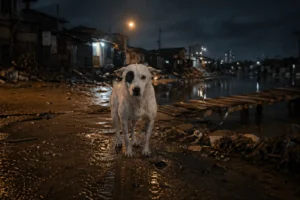
A week later, we took in a second dog. We found her on a stormy night, wedged between a chicken wire fence and a tangle of branches over a dirty canal. That’s Isla’s story — and it’s a different kind of story altogether.
Japanese content: フィリピンで犬を拾った日のこと―アスピンのアンバーと、夫31歳の誕生日