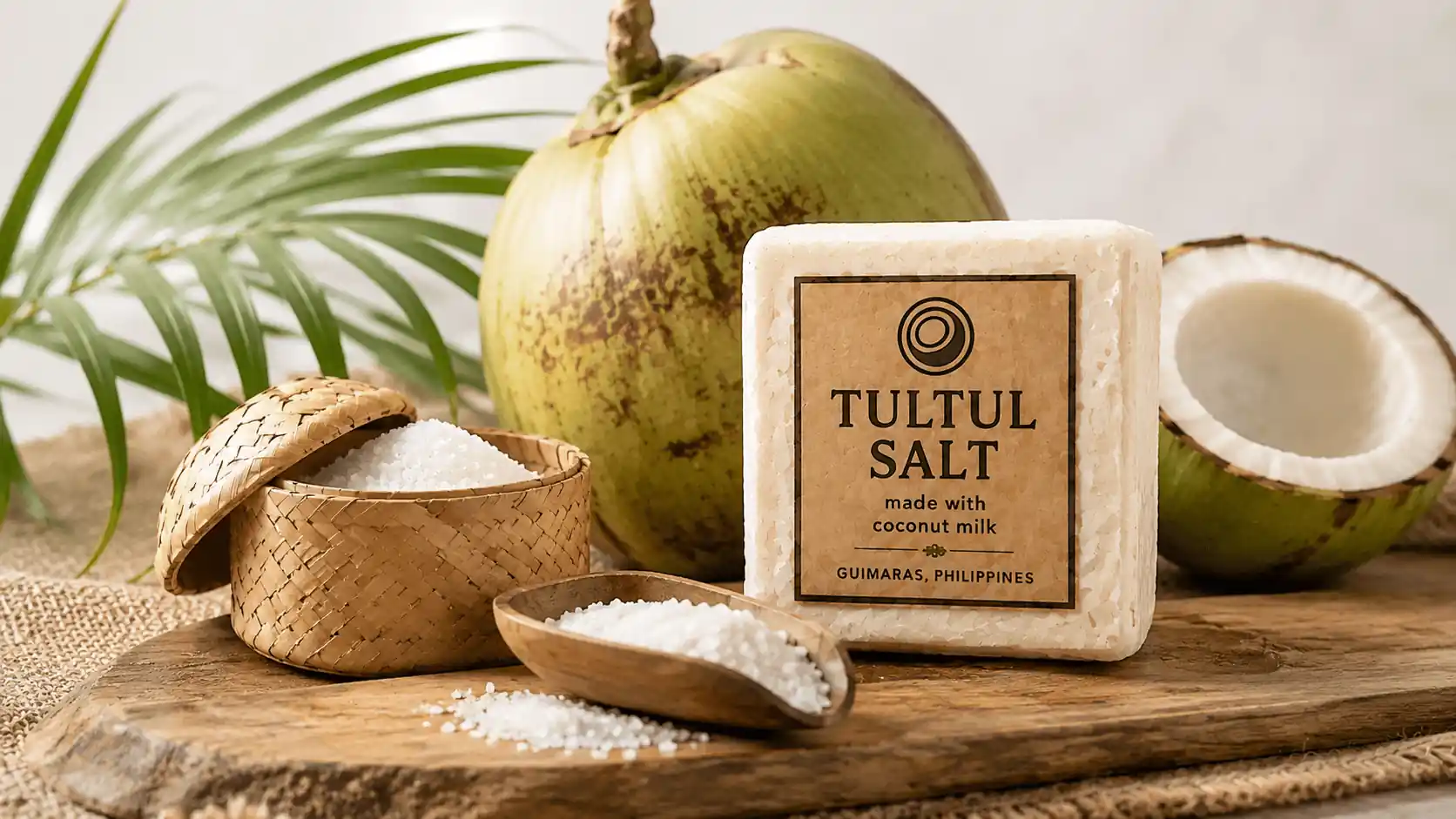
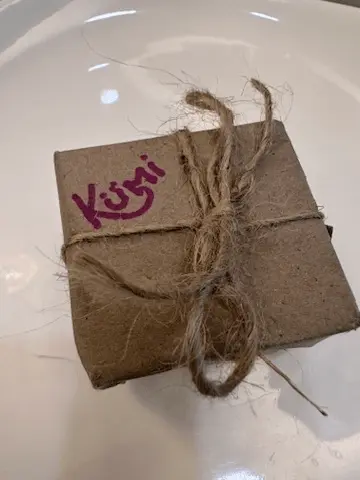
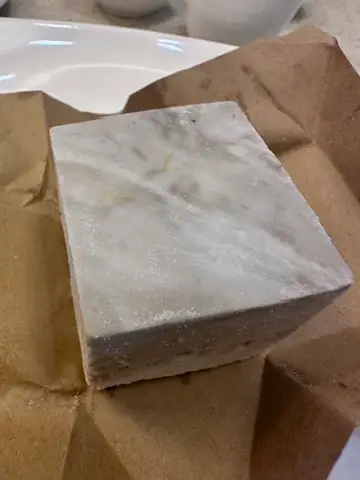
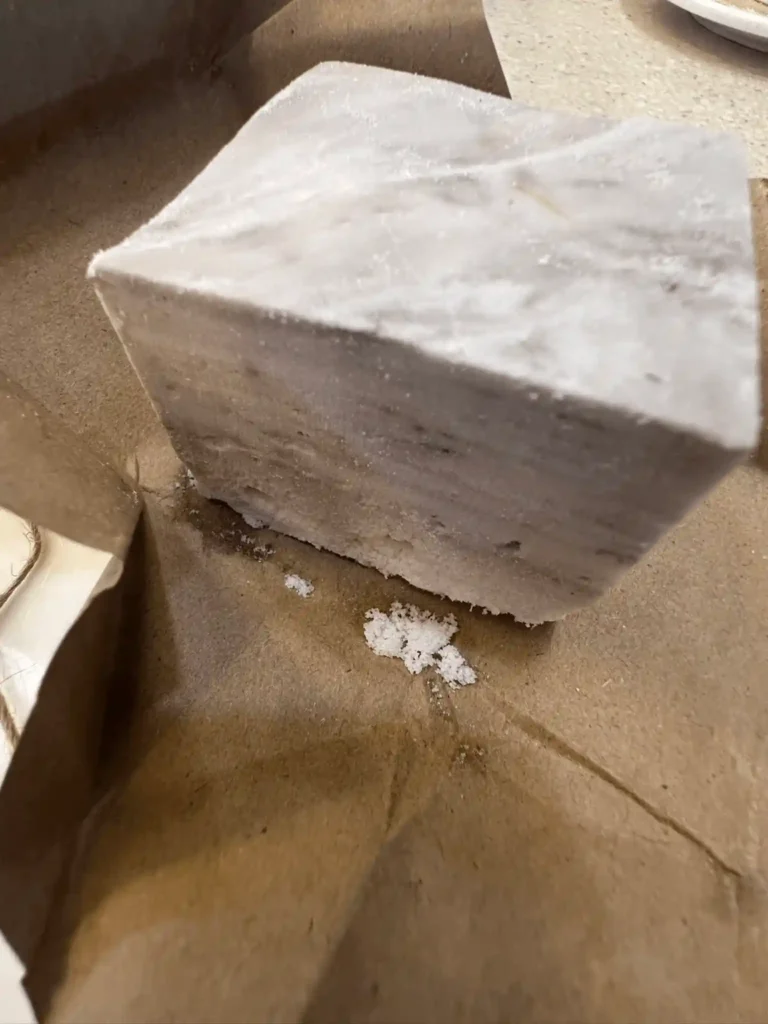
One day, my friend Ariel messaged me: “Found something interesting.” Inside the package was a heavy, dense block of salt. “Tultul,” apparently.
He explained that it’s an incredibly rare salt still made by only a handful of artisans on Guimaras Island — and that unlike regular sea salt, it’s made with coconut milk. Salt with coconut milk? Honestly, I couldn’t quite picture what that meant.
Normally I buy Pangasinan sea salt for everyday cooking, or pick some up from roadside sellers in coastal towns — cheap, local, no frills. This was on another level entirely: Ariel found it online for around 300–400 pesos, versus under 100 pesos per kilo for what I usually buy.
Tultul comes from Barangay Hoskyn in Jordan, Guimaras — a traditional sea salt kept alive by only a handful of remaining artisans.
Bohol has a similar handmade salt called Asin Tibuok. Tultul is basically its “cousin” — the process is nearly identical, except Tultul adds coconut milk (gata).
Eight to ten hours. And that’s just the boiling — add in the days of gathering, burning, and filtering, and it’s an almost unimaginable amount of labor.
Why Coconut Milk? Nobody Really Knows
This is the part I found most fascinating.
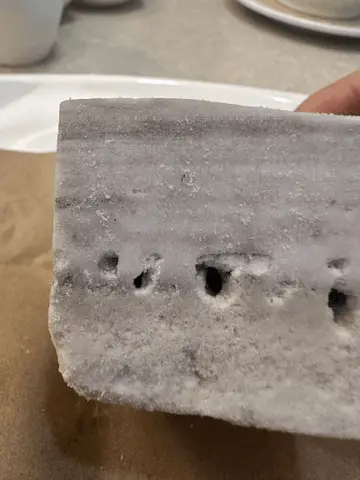
A cross-section of salt made with coconut milk. As the story goes, a man named Semion Ganila from Hoskyn came up with this method in the late 1890s to support his poor family, at a time when Guimaras had few houses and few opportunities for work. Though interestingly, Joemar Ganila — the current, fifth-generation salt maker — says his family’s tradition actually began in 1937, with his ancestors. The sources don’t quite agree on the timeline, and Tultul isn’t the only well-loved Filipino food with a murky origin story — ube halaya has one too . It seems there isn’t one single, settled record of exactly who took that first step.
Seawater was abundant. Driftwood washed up on shore. Coconuts were everywhere. Fire could be made. Working with whatever was at hand, through trial and error — that’s apparently how Tultul was born. This “make do with what you’ve got” spirit feels, to me, like it connects to something deeper about how Filipinos tend to push through hard days with whatever they have.
But here’s the thing: nobody actually knows why coconut milk specifically got added. Even the people making it today can’t say for sure. Since there’s no record, everything from here is pure speculation on my part — take it as such.
Ariel’s theory was: “Maybe it was for preservation?” But even as he said it, he scratched his head: “Wait, but salt is already pretty shelf-stable on its own…” And we both went, “…huh.”
“Well, maybe ‘preservation’ didn’t mean keeping the salt itself from going bad — maybe it meant keeping the block from falling apart,” Ariel said. If you just boil down seawater, you normally get loose, dry crystals, not a solid mass. Maybe the fat and protein in coconut milk act as a binder, holding the crystals together — and maybe a coating of fat on the surface also helps it resist moisture in a place as humid as the Philippines.
There’s one more thing I keep wondering about: could the flavor itself have been lost to oxidation? During those 8–10 hours of simmering, the fat and sugars in the coconut milk might scorch, and whatever mellow flavor it was meant to add could just burn off (more on this when I get to the taste — think of it as foreshadowing). If that’s true, the milk was never really doing much as a flavoring — its real job may always have been structural, holding the block together.
There’s something very Filipino, I think, about a tradition surviving for over a century without anyone quite knowing why it started the way it did.
Tultul Wasn’t Really a Condiment — It Was a Meal
One more surprising thing: how Tultul was traditionally eaten.
When there was nothing else to eat, people would pour oil (or lard) over hot rice and press the Tultul block against it bit by bit to season it — sources describe this as an actual documented practice. It wasn’t really a “seasoning” so much as a side dish in its own right — the thing that made the meal a meal.
I’ll talk more about just how salty it actually is when I get to the tasting part, but knowing this wasn’t born as some luxury condiment, but as a survival strategy for getting through a meal with nothing else on hand, changes how I see it a bit. When you’re hungry enough, maybe that saltiness doesn’t register the same way.
Actually Tasting It
Okay, the moment of truth. I’ll be honest here.
I was expecting something like a regular sea salt, but with the richness and roundness that coconut milk might add. One seller’s product description even claimed the coconut milk “mellows and neutralizes the saltiness,” leaving a mild, smoky finish. Instead, the first thing that hit me was an ashy note. The saltiness itself was noticeably sharper than the rock salt I normally use. Tasted straight, it was sharp-edged — the opposite of mellow. Ariel and I looked at each other and just laughed: “Where exactly is the ‘mild’ part supposed to be?”
What surprised me was cooking with it. That sharpness disappeared — though I suspect that’s partly just down to quantity. Because it’s so potent, a little goes a long way, and in our house a small pinch is plenty. As for mellowness, I’d still say a regular sea salt wins on that front. It’s less that Tultul mellows out and more that you simply use less of it.
I came across a review online that said something like, “This is a finishing salt — the kind of thing you add right before serving, not during cooking.” That made a lot of sense to me. It’s not a salt that’s complete on its own; it needs food to bring out its character.
As for how to use it: apparently the standard method is grating it with a fine grater, and some reviews mentioned it being frustratingly hard to grate. Mine, though, turned out to be surprisingly crumbly — a spoon was enough to scrape some off. Not sure if that’s just variation between batches, or how it was stored.
Tasted on its own, it might honestly leave you a little underwhelmed. But a salt that only really shows its character once it meets food — that was a first for me, and genuinely interesting.
It easily crumbles into a powder. You can simply scrape off as much as you need with a spoon, but if you need a larger amount, grating it might be easier. Beyond “A Dying Tradition”
Labor-intensive traditional foods like this are usually described as fading away — a casualty of iodization laws or a lack of successors. Tultul’s cousin, Asin Tibuok, is even listed in the Slow Food Foundation’s “Ark of Taste,” a catalog of disappearing traditional foods.
But the producers themselves have pushed back on that framing. Their Facebook page put it plainly: they’re done with words like “dying” and “vanishing.” What used to be just one maker and his father is now a community of around 25 people. The industry took a hit after an oil spill (likely the 2006 Guimaras oil spill) nearly wiped out their livelihood, but a man named Alejo Vincent “Vinsoy” Abawan helped rebuild demand by connecting the family with chefs and restaurants. It’s less a dying tradition than a comeback story.
That framing got me thinking about something else, though. Tultul has a real maker, a real place of origin, a Facebook page — it looks “legitimate.” But a label only proves traceability, not safety; even branded salts like Himalayan pink salt have tested positive for lead. And the family-run tradition isn’t the only kind of “visible” producer, either — the people selling salt roadside in coastal towns are just as visible, label or not. If anything, I worry more about the opposite: the more that formal certification becomes the standard, the more small producers who can’t meet it get pushed out. Still, for Tultul at least, the maker’s face is visible. That feels like enough.
Wrapping Up
Taste-wise, it might not be for everyone. But knowing that this is a technique one family invented over a century ago just to survive — and that it’s still being carried on today, not as a dying tradition but as an industry creating jobs and growing a community — changes how a single chunk of it looks to me now.
Why coconut milk, exactly? Nobody will probably ever really know. But there’s something fitting, in a very Filipino way, about a tradition that’s kept going for this long without a clear answer.
By the way — it runs about 280–300 pesos on Shopee, but when I messaged the family directly, they quoted me 180 pesos (plus shipping). Given it’s their own family’s industry, I might just order straight from them next time.
Thanks for the interesting find, Ariel.
Japanese article : https://pinashaponlife.com/food/tultul-coconut-milk-salt/
Sources