If you’ve ordered a drink at Starbucks recently, there’s a decent chance it was purple. Ube — the vivid violet yam from the Philippines — has spent the last year becoming the food world’s most talked-about ingredient, and 2026 might be the year it finally overtakes matcha.
Starbucks has rolled it out across the US and Europe. Costa followed. Ube menu items in US restaurants have jumped 230% over the past four years, and it’s now on the menu at 95 chains. Google searches for “ube” topped 156,000 in a single month. Every bakery counter, every café, every “what’s trending” list seems to have gone purple. (If this matcha-vs-ube comparison intrigues you, I’ve also written about how halo-halo relates to Japanese kakigori — another case of a Filipino dessert with an unexpected cross-cultural thread.)
Here in the Philippines, though, ube isn’t a trend — it’s just there, every day, in a form that’s almost too convenient. Ready-made ube halaya comes in bags at the baking store. Ube cake, ube bread, ube coffee: all a five-minute errand away. Buying a whole raw tuber, peeling it, boiling it, and turning it into halaya yourself takes real time and effort — so most people, especially in cities, understandably don’t bother. Why would you, when the packaged version is right there?
I’m one of the people who never bothered, either. Worse, I was quietly skeptical of the stuff — and not without reason. Japan has its own purple sweet potato, beni-imo, and I’d had plenty of sweets made with it over the years. They always tasted milder, more subdued, more like something that actually grew in the ground. Ube products, by comparison, tasted like someone had turned every dial up. Beni-imo and ube aren’t the same crop, so it’s not a perfect comparison — but it was enough to plant a seed of doubt. Something in me just didn’t buy that the color and sweetness were entirely natural.
Meanwhile, as demand for ube abroad has exploded, a separate problem has surfaced. Some overseas vendors, unable to keep up with supply, have started substituting real ube with purple sweet potato, taro, or plain food coloring. One food writer summed it up bluntly: people are drinking “ube” everywhere now, but most of them have never actually tasted the real thing.
So I decided to skip the shortcut for once. I went to a market, bought a whole raw ube tuber — the kind most people around me don’t bother with — and made everything from scratch myself. Here’s what nobody tells you.
Wait, I’ve never actually seen raw ube
Curious, I asked my Filipino husband: “Have you ever actually seen raw ube?” He thought about it and said, “…Now that you mention it, no.” (You can read more about our life together in what it’s actually like being married to a Filipino.)
That answer surprised me. If someone who’s lived here his whole life hadn’t seen it, maybe raw ube really was harder to find than I assumed. I mentioned this to Ariel, a 60-year-old family friend, expecting him to agree.
He didn’t. “What are you talking about? Any big palengke sells it.”
So Ariel took us to Mahogany Market in Tagaytay — a well-known market that draws plenty of tourists, not some hidden local secret. I’d pictured raw ube looking like the photos I’d seen online: small, tidy, shaped like a sweet potato. I walked through the market scanning for exactly that.
I lost track of Ariel for a moment. Then I spotted him — his shaved head sticking up above the crowd, standing in a quieter corner away from the colorful fruit stalls, pointing at something.
It was a pile of what looked like enormous tree roots, brown and gray, stacked in a styrofoam box.
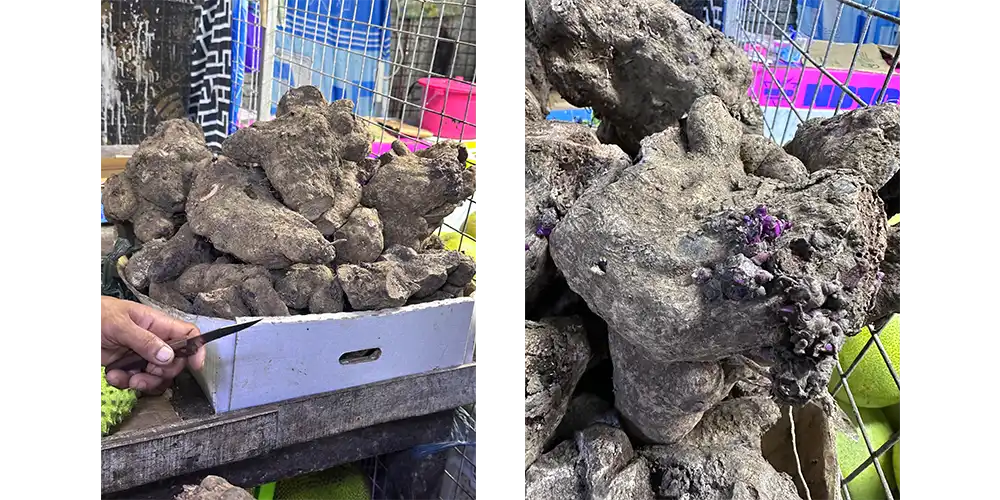
That was ube.
The surface was hard and dry — the kind of thing that could knock you out cold if someone hit you with it. I picked one up: heavy, about 30cm long, with a sliver of purple flesh peeking through a crack in the skin.
I stood there for a second, genuinely stunned — not because it looked ugly, but because of the sheer size and roughness of the thing. What came to mind, oddly, was a giant amethyst cluster: a rock-like exterior with just a sliver of vivid purple peeking through. This hulking thing was somehow the same ingredient behind every dainty purple latte and cake I’d seen. A few other people were browsing the same box — clearly not everyone skips the raw stuff, even if most people do.
I only wanted a little. Enough to boil and try plain, with a bit of butter — nothing fancy. If it tasted good, maybe a small batch of jam too.
“Wait — two kilos? Talaga?” My husband’s voice cracked.
Apparently, buying in bulk is just how it’s done here. Ariel breezily assured us that boiled and frozen ube keeps for two years. (It doesn’t — I checked later. Two months is closer to the truth.)
Turns out Ariel never said that — I probably just misheard him. He likely said something more like “keeps a long time.” Sorry, Ariel!
So, sweating slightly, we walked away with two kilos of raw ube.
The skin-peeling ordeal
Peeling fell to my husband. A regular vegetable peeler was never going to touch that bark-like skin, so he grabbed a knife instead, hacking off the rough outer layer and cutting the flesh into rough 4cm cubes.
Partway through, he mentioned his hands and arms were itching.
“My hands and arms are so itchy… like I got hit by a swarm of mosquitoes all at once.”
He wasn’t put off by it exactly — more resigned, like it was just part of the job — but it clearly wasn’t comfortable. He kept going anyway, and the itching didn’t fade quickly either; it lingered well after he’d finished peeling.
Turns out raw ube sap contains something that irritates skin on contact. I quietly thanked my past self for delegating this job. Lesson learned: if you’re peeling raw ube, wear rubber gloves. Bare hands are a mistake.
🔄 Correction (July 10, 2026)
Before: This article described peeling and cubing the raw ube before boiling it, without noting that this differs from tradition.
After: The traditional method is actually the reverse — boil the tuber whole, skin on, then peel and grate it while it’s still warm. We did it backwards.
Why: A Filipino friend, Ariel, pointed this out after the article was published, and it checks out — every traditional recipe I could find boils ube whole with the skin on. Peeling and cubing first exposes more surface area to the water, which likely explains the fibrous, slightly waterlogged texture I describe in the next section.
What raw ube actually tastes like
After ten minutes of boiling, I finally tried it.
The first surprise was the color. It wasn’t the electric purple I’d seen a thousand times online — it was muted, natural, almost gentle. Slightly bluish after boiling, if anything.
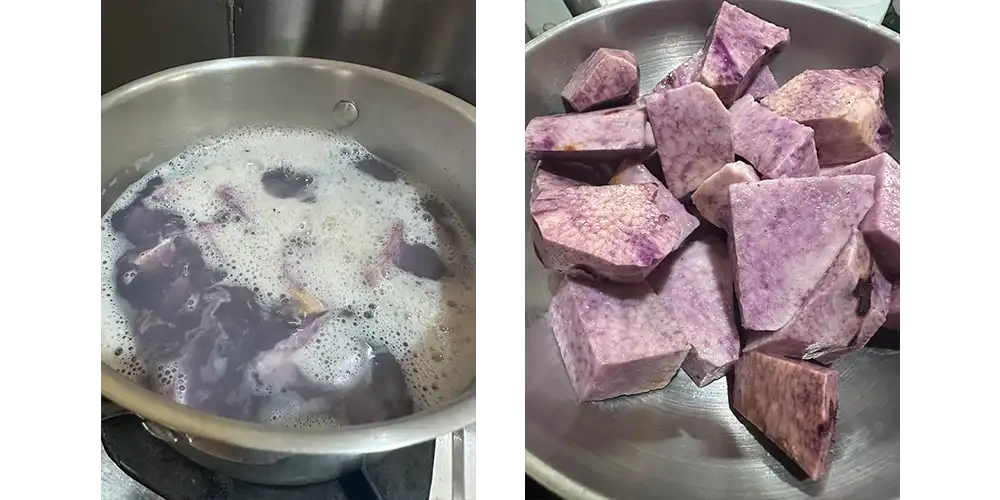
The flavor was subtly sweet, but nowhere near what I expected. Nothing about it screamed “dessert ingredient.” If anything, it felt like the sugar and coconut milk in every recipe exist specifically to bring that flavor out — raw ube on its own is more of a whisper than a shout.
Texture was the real surprise. Ten minutes of boiling left it noticeably fibrous, yet somehow sticky at the same time — a combination I’ve never encountered in a regular potato.
Honestly, it wasn’t appetizing to look at. My original plan — eating it plain with butter — quietly died right there on the cutting board.
“This has to become a paste,” I thought. And that, I suspect, is exactly why you never hear about savory ube dishes. Unlike taro, which shows up in soups and stews across Filipino cuisine, ube stays almost exclusively in dessert territory. The one real exception I found is sinigang sa ube — a version of the classic sour soup made with ube instead of taro — but even that reads more like a curiosity than an actual home-cooking staple. The fibrous, starchy texture that makes ube such a good paste seems to be exactly what keeps it out of savory cooking.
Why commercial ube tastes so intense
So if raw ube is this quiet, muted thing — why does everything made from it taste and look like a neon explosion?
Part of the answer is uncomfortable. As global demand for ube has surged, supply hasn’t kept pace, and some overseas vendors have reportedly started cutting corners — using purple sweet potato, taro, or straight-up food coloring instead of the real thing, according to CNN’s reporting on ube’s global rise. Filipino farmers, meanwhile, are struggling to keep up: domestic ube production has actually been declining even as exports rise, forcing the Philippines to import ube from Vietnam just to meet its own demand, as FoodNavigator notes in its coverage of the trend. The government has started responding — the Bureau of Plant Industry recently distributed over 60,000 ube planting materials to farmers in Leyte and Bohol — but the total value of that support was only around $42,000. It’s a start, not a fix.
But I don’t think substitution is the whole story. There’s a second, quieter reason, and it has nothing to do with fraud.
I’m Japanese, and Japanese food culture tends to favor restraint — muted natural colors, less sugar, “sugar-free” as an actual selling point on packaging. So when I first tried ube products here, my instinct was that they’d been artificially amped up. But a conversation with a Filipino friend made me reconsider.
She’d just come back from a trip to Japan — loved almost everything about it, except one thing: the drinks. “I went to Starbucks and ordered a Frappuccino,” she told me, “and it had no taste!” What she meant was that it wasn’t sweet — at least not by Filipino standards.
That stuck with me. Filipino drinks and desserts tend to run sweeter than what I grew up with, and I suspect that same palate calibration extends to ube. The commercial products aren’t necessarily lying about the ube inside them — they might just be genuinely, unapologetically sweet in a way that reads as “too much” to a palate tuned differently. Combine that with a supply chain occasionally cutting real ube with substitutes, and you get the ube most people abroad have actually experienced: intensely purple, intensely sweet, and only sometimes intensely real. (Taste preferences shaping which foods take root where isn’t unique to ube, either — I’ve written before about why tea never quite caught on the way you’d expect in the Philippines.)
The version I made in my own kitchen was neither of those things.
Ube Halaya vs. Ube Jam — what’s the actual difference
Before getting into how I made mine, it’s worth clearing something up — I didn’t actually know the difference myself until I looked into it.
Outside the Philippines, “ube jam” and “ube halaya” often get used interchangeably. Inside the Philippines, they’re not the same thing.
Ube jam is softer and more spreadable than halaya. It’s less a standalone dessert than something you put on pandesal or toast.
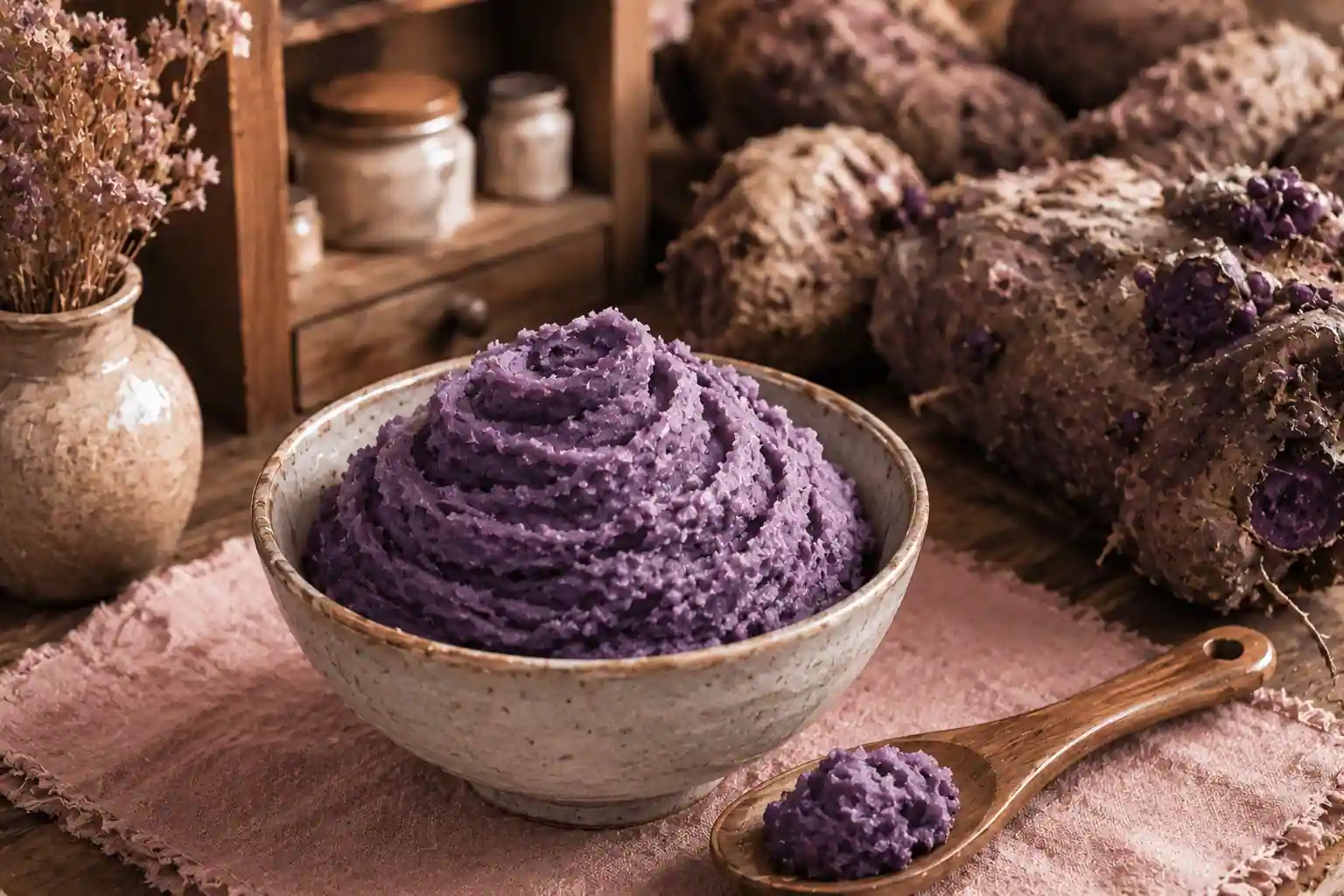
Ube halaya is closer to what Americans would call a sweet potato casserole — but because ube is starchier than sweet potato, it comes out thicker and denser. It’s made by cooking mashed ube slowly with butter, sugar, and coconut milk until it thickens into a rich, spoonable paste.
Interestingly, the word “halaya” itself comes from the Spanish word for jelly — so etymologically, “jam” and “halaya” started out meaning almost the same thing. Filipino households just quietly split them into two separate dishes over time.
How I actually made it (my low-sugar version)
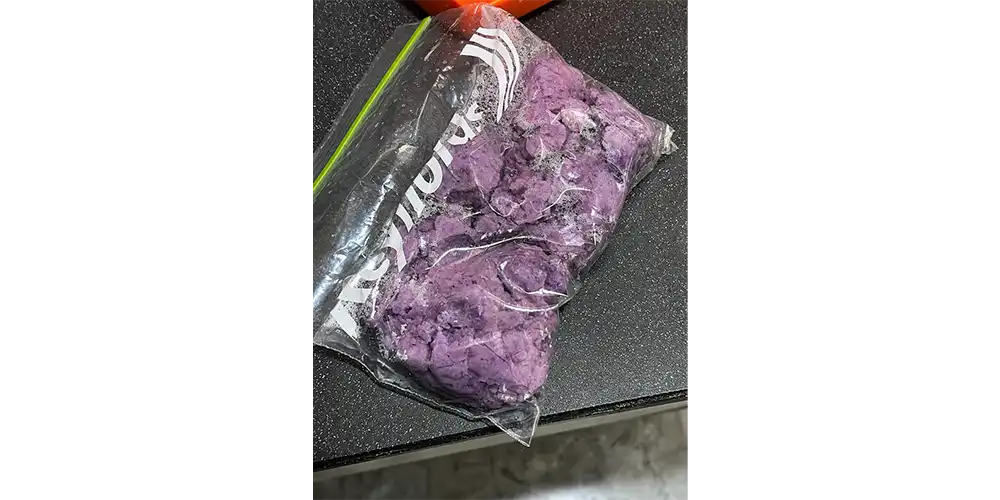
Ube Halaya (Reduced Sugar)
- 500g boiled ube, mashed
- 150–200ml coconut milk (or regular milk)
- 20–30g butter
- 1/4 tsp salt
- 1–2 tbsp honey or brown sugar (optional — skip entirely if you want it less sweet)
- A splash of vanilla extract (optional)
- Mash the boiled ube while it’s still hot. Pushing it through a sieve gives a smoother result, but a fork works fine.
- Put everything in a pot over low heat.
- Stir with a wooden spoon for 15–20 minutes as the moisture cooks off and it thickens into a cream.
- Taste and adjust sweetness.
- Let it cool — it firms up as it does.
The moment that nearly broke me was adding the coconut milk and butter. The purple got swallowed by a milky white mass that looked, for a horrifying second, like I’d poured glue into the pot. “Is this ever going back to purple?” I remember thinking.
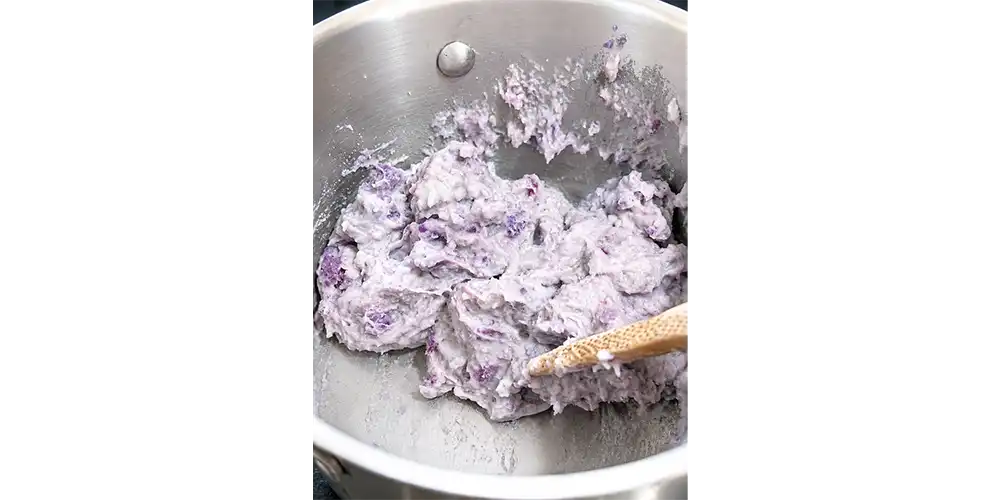
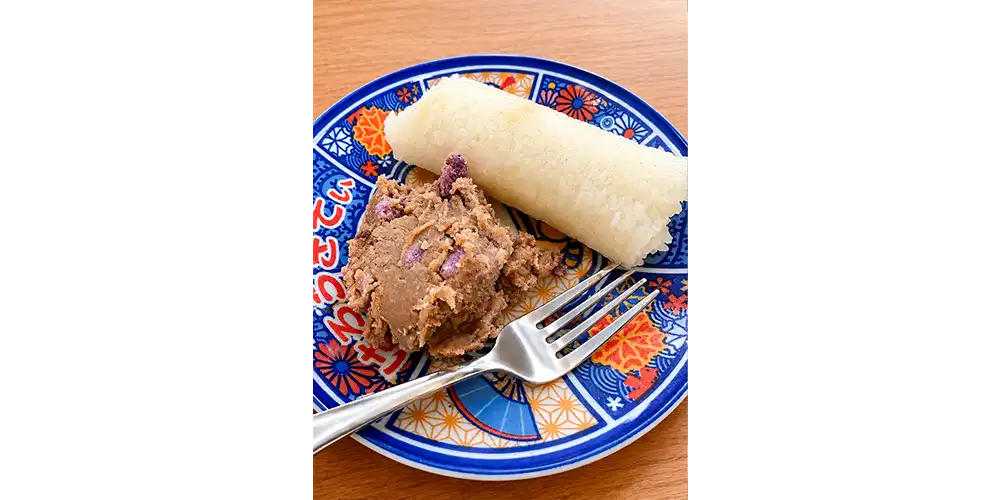
We don’t own a blender, so I just kept stirring by hand, sweating over the pot, until slowly — reluctantly — the purple won out. What emerged was an elegant, deep violet halaya.
As for the flavor: it’s hard to describe. Something like the taste of tropical sunlight, if that makes sense — with a richness that reminded me of roasted chestnuts. Coconut milk seems to unlock ube’s full flavor potential, butter adds depth, and sugar just gives it a final edge of character.
Most recipes call for condensed milk too. I left it out — anything overly sweet has gotten harder for me to enjoy past 40 — and relied on ube and coconut milk’s natural sweetness instead. What I ended up with is something I’d describe as a distinctly Filipino cousin of Japanese anko (sweet red bean paste): earthy, only moderately sweet, and clearly its own thing.
Variation 1 — Simpler Just ube, coconut milk, a little butter, a little salt. No added sugar at all. This lets the natural ube aroma come through more.
Variation 2 — Even simpler Ube, coconut milk, salt — no butter. Delicious, but the texture reads more like purple mashed potato than a dessert. Less “spread it on something,” more “eat it with a spoon.”
Ube Jam (Reduced Sugar)
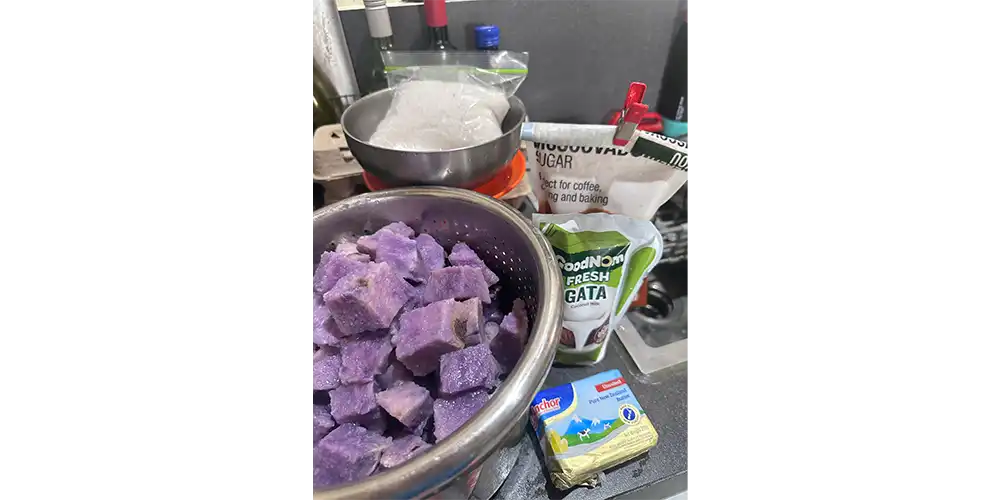
- 500g boiled and mashed ube
- 200ml coconut milk
- 100ml milk (optional)
- 20g butter
- 50–100g sugar (typical recipes use 200–300g — this is deliberately much less)
- 1/4 tsp salt
- A splash of vanilla (optional)
- Combine everything in a pot.
- Cook over low heat for 20–30 minutes, stirring constantly so it doesn’t scorch.
- Stop once a spoon dragged through it leaves a visible line — you want it a little softer than the halaya.
Variation — Ube Spread For something even lighter: ube, coconut milk, butter, a pinch of salt, 1 tbsp honey. No real “jam” texture, but great on bread. Keep it 2–3 days refrigerated, or freeze it.
I used muscovado sugar, which is why mine came out on the brownish side of purple, and sea salt from Pangasinan — small details, but ones that shaped the final flavor.
A quick nutrition note
Given how unimpressive raw ube looks, it’s surprisingly solid nutritionally.
Per 100g, ube runs around 118 calories with 4.1g of fiber. It covers roughly 40% of your daily vitamin C needs and about 13% of your potassium needs in a single serving.
That vivid purple color comes from anthocyanins — the same class of antioxidants found in blueberries. Compared to sweet potato, ube also tends to have a gentler effect on blood sugar, making it a lower-GI option. (Source: Healthline — 7 Benefits of Purple Yam (Ube))
Not bad for something that looked, at the boiling stage, like it belonged in a compost bin rather than a bowl.
🔄 Correction (July 10, 2026)
Before: This section presented the vitamin C figure above (40% DRI) as if it applied to the finished halaya or jam.
After: That number is for raw ube. It doesn’t carry over intact to the cooked product.
Why: Vitamin C is heat-sensitive and water-soluble. Peeling and cubing before boiling (rather than boiling whole, skin-on — see the correction above) exposes more surface area and likely increases the loss. On top of that, the halaya and jam are cooked a second time. I haven’t measured the actual retained amount, so the honest takeaway is “a nutritionally solid tuber,” not a precise number for the finished dessert.
Why ube matters so much in the Philippines (it’s not just Instagram)
Before this trip to the market, I honestly assumed ube’s popularity was mostly a color story — vivid, photogenic, easy to market. Digging a little deeper suggested something older and less shallow.
Charred remains of ube and taro have reportedly been recovered from the Ille Cave site in Palawan, dated to roughly 8250–3050 BCE — somewhere between 5,000 and 10,000-plus years ago, long before rice became the region’s staple crop. In Batanes, the Ivatan people reportedly relied on ube as a primary food source before rice was widely available, and it’s still treated as something special there — served on important occasions, given as gifts to guests.
Bohol adds another layer to the story. Its “kinampay” variety of ube is said to have helped sustain people through hard periods like war and drought — and Bohol’s own provincial hymn, “Awit sa Bohol,” includes a line honoring the sweet kinampay, a nod to how deeply the crop is woven into local identity there. (Source: VERA Files — Know your Philippine Ube)
What we went through — hacking through bark-like skin, dealing with itchy sap, babysitting a pot for twenty minutes so it wouldn’t scorch — is, in miniature, the same effort that’s turned this crop into something reserved for special occasions for centuries. The labor isn’t incidental to ube’s status. It’s part of what created it.
Closing — what I actually think now
I’ll be honest: the flashy ube drinks and desserts that are everywhere right now still aren’t really my thing. That intense purple, that tooth-aching sweetness — I still find it a bit much.
But the halaya I made myself, with barely any added sugar, was genuinely good. That earthy, sun-warmed sweetness, the faint chestnut-like richness — I don’t think you get that from the packaged stuff. It’s a flavor the commercial version mostly buries.
What stuck with me most, though, wasn’t the taste. It was the gap. Behind every glossy purple latte and Instagram-ready dessert is this ugly, heavy, dirt-covered root that nobody photographs — one that takes real effort to turn into anything at all. The polished surface and the messy reality underneath. That contrast is, honestly, the whole point of this piece.
If you ever find yourself at a market in the Philippines, look for it — don’t just walk past the tidy displays. Buy a piece, take it home, peel it (with gloves), boil it, and stir it into something yourself.
You’ll end up with something better than what’s in that latte. And you’ll understand ube in a way no article — including, frankly, this one — can fully substitute for.
That gap between the glossy surface and the effortful, unglamorous reality underneath shows up again and again if you spend enough time in the Philippines — I’ve explored a version of the same theme in why Filipinos smile.
🇯🇵Japanese article : 実際にウベを煮て作ってみた!