When we were living in Metro Manila — right in the middle of the COVID pandemic — we got an announcement: 48 hours without water. And on top of that, a large-scale power outage was coming, with no clear end date.
Our water is pumped electrically, so no power meant no water — a double punch. We’d been dealing with water outages on and off for more than half a year by that point, but you never really get used to it. My heart kept sinking lower.
I muttered without thinking: “I can’t take this anymore. Water out, water out, water out, every single day…”
My husband smiled and said:
“The 90s were way worse than this. Compared to back then, this is nothing.
And honestly — we’re so lucky, aren’t we?
I’m just really happy we get to live together every day.”
How can anyone say that so cheerfully in a home with no running water?
Meanwhile, my father-in-law came in with good news: “They said two days, but apparently it’ll only be one.” His eyes were lit up — he was proud to have gotten the information before anyone else.
Even after more than ten years living in the Philippines as a Japanese person, I still can’t quite reach this ability to reframe any situation into something positive.
And yet — they really are smiling. Shrugging and saying “well, can’t be helped” while enduring things that would break most people.
Why Are Filipinos So Mentally Strong?
Imagine your home floods so badly every year that all your belongings are destroyed.
Imagine finding out one day that you were adopted as a child.
Imagine being suddenly fired from your job.
Could you still smile?
Most Filipinos might not answer “yes” outright — but somehow, they’ll:
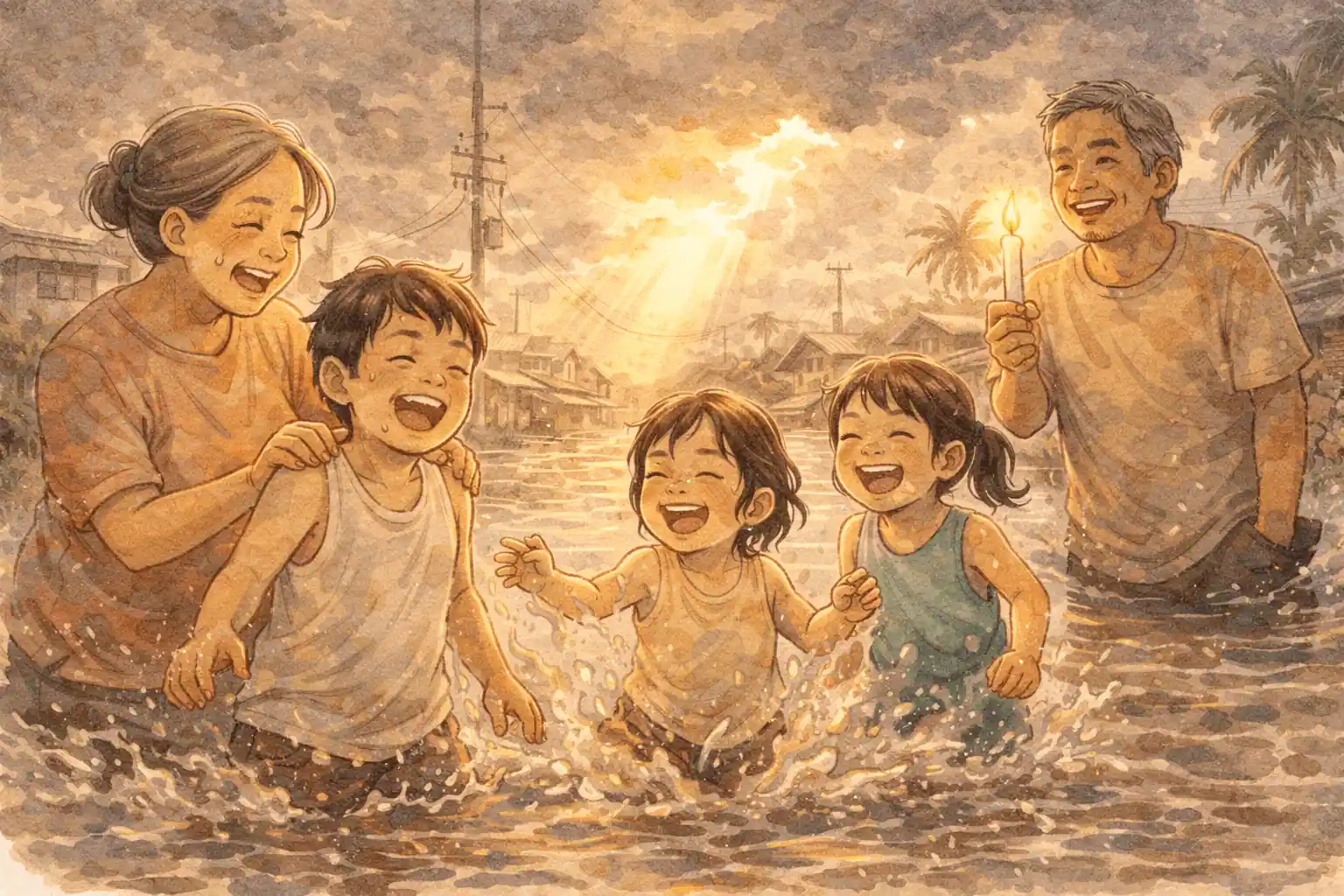
wade into the floodwater with a beer in hand,
turn family secrets into a guessing game,
and dance in front of their old office after getting fired, posting it straight to TikTok.
These are all true stories from friends of ours.
Of course that doesn’t mean they’re not hurting.
So why — why are they able to stay so positive?
What Supports the Filipino “Unbreakable Spirit”
1. Community and Family Bonds — Kapwa and Bayanihan
“Kapwa” is the Filipino concept of feeling yourself as one with others — a deep sense of shared identity.
“Bayanihan” is the spirit of the whole community coming together to help one another.
In the Philippines, there’s a strong sense of “I am connected to my family and my people.” When flooding hits, the whole neighborhood comes out to carry furniture to safety. When the power goes out, everyone gathers around candles and laughs together.
Not being isolated — facing hardship together — is what holds the heart up.
2. Faith and the Spirit of Bahala Na
“Bahala Na” roughly means “leave it to God” — or simply, “whatever happens, happens.”
At first glance it can seem like resignation. But in practice, it’s actually a courageous posture: do what you can, then let go and move forward. It connects to the Tagalog concept of Maginhawa — the Filipino version of ikigai, but lighter and more at ease.
My husband’s words — “we’re so lucky, aren’t we?” — were the living expression of this spirit.
(For more on how this plays out in everyday family life, see: The Financial Pressure Inside Filipino Families)
3. Humor and Playfulness
Filipinos have a remarkable ability to laugh their way through hardship.
Swimming through a flood, dancing after losing a job — there’s something deeply social about turning pain into comedy. It’s what keeps the community sane, and each other close.
And social media is where that humor and creativity explodes.
| Metric | Data |
|---|---|
| Internet penetration rate | ~83.8% |
| Social media users | ~90.8 million (~78% of population) |
| Share of internet users on social media | ~93.1% |
| Gender breakdown | Female: ~52%, Male: ~48% |
Source: DataReportal – Digital 2025 Philippines
On these platforms, Filipinos churn out memes at a staggering pace — and the creativity is genuinely breathtaking.
4. Hope and Optimism
“Things are tough now, but they’ll get better” — this forward-looking mindset is a real source of strength. The willingness to cross borders in search of opportunity, as so many OFWs do, is a direct expression of that optimism. Being positive isn’t just a personality trait — it’s a practical survival strategy.
5. “Anger Means You Lose” — Pikon Ay Talo
Pikon Ay Talo — “the one who gets emotional loses.”
The idea is that blowing up doesn’t solve anything; it just gives people something to laugh at you for. So it’s better strategy to laugh first. My husband interprets it as: “stay calm, think carefully, and get what you actually want” — and he reminds me of it often. (I can never live up to it.)
6. Structural and Community Support
Because the Philippines faces so many disasters, community mutual aid and NGO activity run deep.
At the same time, people respond to corrupt systems and broken institutions — not with silence, but with jokes on social media. Jokes that don’t forget. That kind of shrewd resilience is part of the mental toughness too.
Did Ancient Filipinos Also Care Deeply About Their Smiles?
This fixation on smiling isn’t a modern thing.
Skulls excavated from the Bolinao site in Pangasinan, dating back to the 14th–15th centuries, were found with intricate gold dental ornaments — golden spots in fish-scale patterns, gold inlays, gold caps — crafted by ancient artisans called mananusad.
In 1617, Spanish missionary Mateo Sánchez recorded the mananusad, noting that the golden smile reflected the sun and made its wearer shine like a hero.
In ancient times, the smile was a symbol of beauty and power.
(Reference: Vogue Philippines – Behind Our Smile)
…Which makes me wonder — could modern Filipinos’ love of orthodontic braces be the direct descendant of this tradition?
I always wondered why so many people here seem to wear those silver braces almost as a fashion statement. Now it’s starting to make sense. I’d love to write about that next.
But of Course, Filipinos Hurt Too
Not everything can be laughed off.
Take the scandal of flood control funds disappearing into “ghost projects” — contracts paid for work never done, money funneled to politicians and contractors.
People turned their rage into jokes on social media. But that wasn’t forgiveness.
Even while saying “anger means you lose,” deep down they were thinking: this cannot stand.
The “Ghost Project” Scandal
A massive series of flood control projects across the Philippines was found to be riddled with ghost projects — funds disbursed for work that was never carried out, with allegations of kickbacks to politicians and contractors. Reported totals reached around ₱545 billion in flood control spending, with significant portions suspected of corruption. The government established an independent commission to investigate.
Real Voices: What Filipinos Actually Feel Inside
Ninong Ry is a popular Filipino YouTuber, chef, and content creator. In the wake of the flood fund scandal, he posted a deeply personal statement. I think it contains everything about the Philippines today.